[email protected]
বৃহঃস্পতিবার, ৮ অক্টোবর ২০২৬
২২ আশ্বিন ১৪৩৩
২২ আশ্বিন ১৪৩৩

Wednesday, 7th October 2026


Bangladesh Urges Global Action to Resolve Protracted Rohingya Crisis
24 August 2026 05:08 AM
NEWS DESK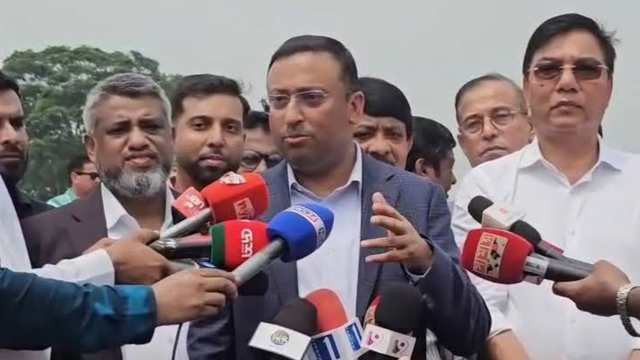
Bangladesh Foreign Affairs State Minister Shama Obaed Islam has called on the international community to shoulder its collective political and moral responsibility to resolve the protracted Rohingya crisis, stressing that Bangladesh cannot bear the burden alone.
“Bangladesh will stand by the Rohingyas, but Bangladesh must not be left to stand alone,” she said while addressing a dialogue titled “10 Years of the Rohingya Crisis: From Humanitarian Assistance to Sustainable Solutions” in the capital on Sunday.
The dialogue was jointly organised by the Diplomatic Correspondents Association, Bangladesh (DCAB) and Oxfam in Bangladesh.
Shama said the approaching 10-year mark of the Rohingya crisis should not merely be a time for reflection, but an opportunity to launch renewed initiatives and ensure accountability.
“We cannot allow another decade to pass without a sustainable solution,” she said.
She noted that while 10 years may represent a policy cycle for a government or a planning horizon for an institution, it represents an entire childhood for a child growing up in a refugee camp, lost educational opportunities for a young person, and a decade of displacement for a family.
“We cannot allow 10 years to become 20 years,” she said.
Referring to Bangladesh’s response since the massive influx of Rohingyas in 2017, the state minister said the country had kept its borders and hearts open and was currently hosting more than 1.2 million forcibly displaced Rohingyas despite its own development challenges, limited land and high population density.
The presence of such a large displaced population has placed enormous pressure on Bangladesh’s infrastructure, environment, public services and host communities, she said. Nevertheless, Bangladesh has continued providing food, shelter, healthcare, education and protection to the Rohingyas out of humanitarian and moral responsibility.
However, Shama stressed that Bangladesh’s humanitarian generosity must not become an excuse for international inaction.
“Bangladesh can provide shelter, humanitarian assistance and help protect human dignity. But Bangladesh cannot solve alone a crisis it did not create,” she said.
Highlighting declining funding under the 2026 Joint Response Plan, she said humanitarian needs remained enormous despite reduced financial support. Food, nutrition, water, sanitation and hygiene, education and protection were not luxuries, but essential requirements for the Rohingyas’ survival.
She warned that a major funding shortfall would affect not only the Rohingya population but also host communities, stability in the camps and, ultimately, regional stability.
Addressing international partners, Shama urged them not to allow humanitarian fatigue to turn into humanitarian abandonment.
She also highlighted the mounting pressure on local communities in Cox’s Bazar, saying their livelihoods, environment and public services had been under severe strain for years. Support for host communities, she added, should be treated as an essential component of humanitarian assistance rather than an optional measure.
Praising the contributions of the European Union and other international partners, the state minister said humanitarian assistance alone could not provide a lasting solution to the crisis.
“The crisis originated in Myanmar. Its sustainable solution must ultimately be found in Myanmar,” she said.
Shama reiterated that the safe, voluntary, dignified and sustainable repatriation of the Rohingyas remained Bangladesh’s ultimate objective.
“This is not simply a political choice; it is the only sustainable path,” she said.
She noted that Rohingyas themselves had repeatedly expressed their desire to return to their homeland, stressing that a refugee camp could never be a permanent substitute for one’s own homeland.
The state minister called for the verification process for repatriation to be expedited under the existing bilateral arrangements. She also urged that children born in the refugee camps and Rohingyas who arrived from Rakhine State after 2017 be considered in the verification process.
Accurate information and a credible verification mechanism, she said, could serve as an important confidence-building measure between Bangladesh and Myanmar.
She said Bangladesh would continue constructive engagement through bilateral channels, the United Nations, regional mechanisms and international partners, while pursuing every possible diplomatic initiative to facilitate Rohingya repatriation.
Regarding China’s role, Shama expressed hope that commitments made by Chinese leaders during Prime Minister Tarique Rahman’s visit to China would be reflected through concrete actions.
She said responsibility-sharing should go beyond expressions of sympathy or solidarity. It must involve effective action, predictable funding, sustained diplomatic efforts, political engagement, accountability and, ultimately, a lasting solution.
The state minister said Bangladesh had responded to what was initially a humanitarian emergency nearly a decade ago, but the situation had now evolved into a protracted political crisis.
Recalling Bangladesh’s experience of Rohingya repatriation in 1978 and 1992, she expressed confidence that the present government would also be able to advance the repatriation process successfully.
Shama also called on the media to play a strong role in ensuring that the Rohingya crisis does not disappear from the international agenda.
“You are not only reporting the crisis; you are also helping shape how the world sees it,” she told journalists, underscoring the importance of responsible journalism, evidence and accurate information.
She urged stakeholders to move from relief dependency to capacity building, from solidarity to responsibility-sharing, from humanitarian management to political action, and from displacement to dignified repatriation.
“The Rohingya people deserve more than survival. They deserve a future, a home, security and dignity, and the right to return peacefully to their homeland,” she said.
Advertisement