[email protected] মঙ্গলবার, ২৬ মে ২০২৬
১২ জ্যৈষ্ঠ ১৪৩৩

India Moves to Strengthen Strategic “Chicken’s Neck” Corridor

26 May 2026 22:05 PM

NEWS DESK

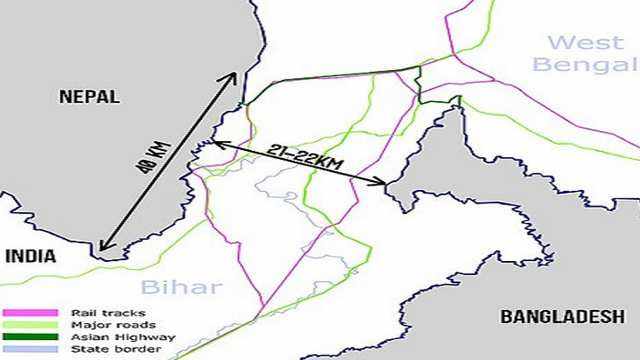
Photo: Graphics

The Indian central government has reportedly stepped up new initiatives surrounding the strategically vital Siliguri Corridor — commonly known as the “Chicken’s Neck” — with plans to transform northern Bengal into a major security and economic zone.

According to administrative and intelligence sources, the initiative combines border security, military preparedness, infrastructure development, and regional economic expansion.

The narrow land corridor serves as the only direct connection between mainland India and its northeastern states. Surrounded by the borders of Bangladesh, Nepal, and Bhutan, the region has long been considered highly sensitive in India’s national security strategy.

Its importance has grown further because of its proximity to the Chumbi Valley in Tibet near the China border, making the area strategically critical from a military perspective.

Recent reports indicate that new military installations are being developed in Chopra, Dhubri, and Kishanganj. Sources also suggest that specialized army units equipped with advanced missile systems have been placed on heightened readiness.

At the same time, several major roads in northern Bengal have reportedly been brought under the supervision of India’s central road authorities as part of broader infrastructure modernization efforts.

Officials say the measures are not solely military in nature. New Delhi is also aiming to develop northern Bengal into a major economic and connectivity hub centered around Siliguri, linking both the Himalayan hill regions and surrounding plains into a larger strategic zone.

Under the proposed plans, border roads would be upgraded to four-lane highways, alternative mountain routes constructed, and airports and railway infrastructure modernized. Authorities are also focusing on boosting international trade through the region.

Experts believe that successful implementation of these projects could significantly increase trade with Bangladesh, Nepal, and Bhutan, while turning Siliguri into a major logistics and warehousing center.

Some intelligence analysts argue that military strength alone cannot guarantee the security of the Chicken’s Neck corridor. They emphasize that economic development, infrastructure expansion, and improving living standards for local residents are equally important, especially in areas long affected by underdevelopment, political instability, and economic deprivation.

As part of the broader initiative, plans are reportedly underway to invest heavily in healthcare, education, industry, tourism, and technology sectors across northern Bengal. Proposed projects include new industrial zones, modern hospitals, technology parks, and tourism infrastructure, which could generate substantial employment opportunities.

Political observers say the implementation of these plans has become easier following recent political changes in the state, as previous tensions between the state and central governments had reportedly delayed several projects.

However, the initiative has also drawn criticism. Opposition groups have raised concerns that the region may be heading toward excessive militarization in the name of national security, potentially affecting local communities and the environment.

Despite the criticism, the central government appears determined to integrate security, economic growth, and international trade into a unified strategy for northern Bengal. Analysts believe the Chicken’s Neck corridor could soon emerge not only as a border security priority but also as a key center of India’s economic and geopolitical strategy.


Comments Here:

Related Topic