১ কার্তিক ১৪৩৩



Protesters Rally Against IMF, World Bank Policies in Bangkok
16 October 2026 13:10 PM
NEWS DESK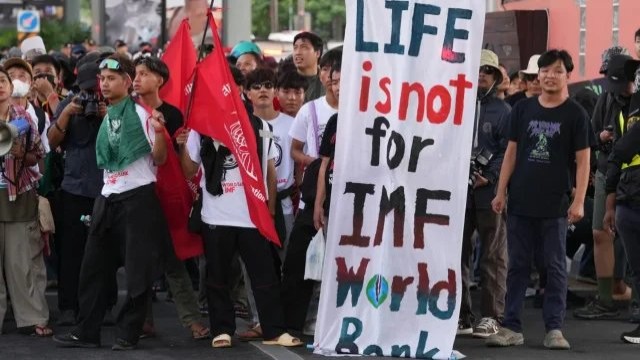
Civil society groups, farmers, workers and environmental activists have staged protests in Bangkok over the past two days, demanding greater transparency in lending policies, economic justice and public participation in development decisions during the annual meetings of the International Monetary Fund (IMF) and the World Bank.
The demonstrators attempted to march towards the conference venue but were stopped by police, disrupting traffic on several roads around the meeting centre.
The protests took place near the Queen Sirikit National Convention Centre in Bangkok, where the IMF and World Bank annual meetings are being held.
The protesters alleged that international financial institutions do not adequately consider ordinary people's interests when making decisions on loans and development policies. They argued that the financial and social costs of such decisions often fall disproportionately on farmers, workers, low-income households and local communities.
Demands for transparency and accountability in lending
One of the protesters' main demands was greater transparency in loan agreements between governments and international financial institutions, as well as in decisions concerning development projects.
They called for affected communities to be consulted before policies or projects that could threaten their livelihoods and living conditions are approved.
The demonstrators also demanded the disclosure of loan agreements, a review of opaque and unfair lending arrangements, and stronger accountability for government loans and guarantees issued for projects without public consent.
They argued that citizens have the right to know the costs, interest payments and repayment obligations associated with debt-financed development plans.
Farmers' debt relief and fair taxation
The financial difficulties faced by farmers and rural communities also featured prominently in the protests.
Demonstrators called for debt relief for farmers, fair taxation of large corporations and wealthy individuals, and stronger social protection programmes.
They warned that economic reforms could place additional pressure on low- and middle-income households if they result in higher taxes on ordinary people, reduced subsidies or increased costs for essential services.
They also argued that the benefits of economic reform may not be shared equitably if large businesses and high-income groups face different tax burdens or receive disproportionate government support.
Environmental protection and community rights
Environmental protection and the rights of communities affected by development projects were among the protesters' other key concerns.
They raised concerns that dams, mining operations, industrialisation and large infrastructure projects could damage local environments, displace communities and undermine livelihoods.
The demonstrators demanded adequate compensation for affected people, environmental restoration and consultations with local communities before projects are approved.
They argued that development should not be assessed solely on the basis of economic growth or the scale of infrastructure investment. Its social and environmental costs must also be taken into account.
Traffic restrictions around the conference venue
Authorities imposed traffic restrictions on several major roads in Bangkok to ensure the security of international delegates attending the meetings. Traffic congestion and disruptions were reported around Rama IV and Ratchadaphisek roads.
According to published traffic advisories, restrictions were imposed on both sides of Ratchadaphisek Road, between the Asok Montri intersection and the Rama IV intersection, on October 15 and 16.
A designated section of Ploenchit Road was also scheduled to be closed to outbound traffic from 8am to 1pm on October 16. In addition, the Queen Sirikit National Convention Centre metro station was scheduled to remain closed from 9am to 4pm.
The protests and heightened security measures forced some vehicles to take alternative routes. However, a complete list of roads temporarily converted to two-way traffic could not be confirmed.
Why the protests matter for Bangladesh
The demonstrations in Bangkok have also raised important questions for developing countries such as Bangladesh, where external borrowing plays a significant role in financing development.
The central issue is who benefits from international lending and economic reforms, and who ultimately bears their costs.
In Bangladesh, the debate is relevant to efforts to increase tax revenue, fuel subsidies, banking sector reforms, debt repayment obligations and the effectiveness of social protection programmes.
Particular attention is needed to assess how measures such as tax increases and subsidy cuts affect low- and middle-income households.
However, the protesters' concerns in Bangkok should not be treated as direct evidence of the impact of economic policies in Bangladesh. Their effects must be assessed using country-specific data on loan agreements, public budgets, revenue collection, external debt repayments and social protection programmes.
The protests surrounding the IMF and World Bank annual meetings have brought a fundamental question about international development financing into focus: how can countries pursue economic growth while also protecting people's livelihoods, safeguarding the environment and ensuring social justice?