[email protected]
রবিবার, ২৫ অক্টোবর ২০২৬
১০ কার্তিক ১৪৩৩
১০ কার্তিক ১৪৩৩

Sunday, 25th October 2026


Sheikh Hasina Says Sheikh Selim Will Lead Awami League in Her Absence
08 September 2026 07:09 AM
NEWS DESK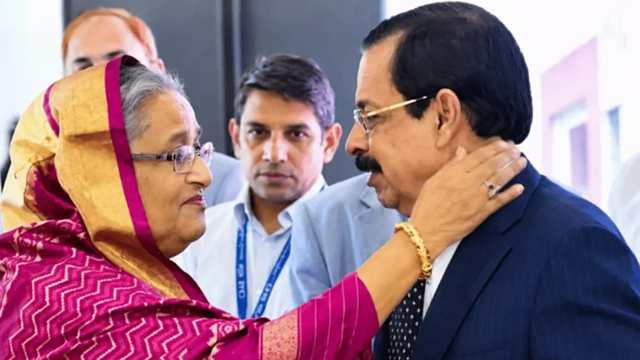
Former Bangladesh Prime Minister Sheikh Hasina has said that Sheikh Fazlul Karim Selim will take charge as president of the Awami League in her absence.
In an interview with Indian news outlet The Wall, Hasina said Selim is currently the party’s senior-most presidium member and would assume the leadership role in her absence.
“Now Sheikh Selim is the senior-most presidium member. In my absence, he will perform the duties of president,” she said.
Speaking about her younger sister, Sheikh Rehana, Hasina said she is not directly involved in politics.
In an extensive conversation with The Wall Executive Editor Amal Sarkar, Hasina discussed her plans to return to Bangladesh, personal security concerns, the country’s current political situation, India-Bangladesh relations and the future leadership of the Awami League.
Hasina reiterated her intention to return to Bangladesh in December, while expressing concern that she could face a threat to her life immediately upon arriving at an airport.
“Everyone’s life is at risk. I do not want to put anyone in danger by giving instructions for my return,” she said.
She said she was preparing for her return and maintaining contact with grassroots Awami League leaders, activists and ordinary citizens.
Hasina said she had deliberately chosen December because it is Bangladesh’s Victory Month.
“I have decided to go in December, not earlier. I am preparing accordingly,” she said.
Asked whether she would return before December if circumstances became favorable, Hasina said December was a deliberate choice.
Hasina also alleged that militant forces are gaining ground in Bangladesh and warned that the consequences could extend beyond the country’s borders.
“India will also have to pay the price for the rise of militants in Bangladesh,” she said.
According to Hasina, instability in Bangladesh and the expansion of extremist forces could have implications for India’s security and regional stability. She argued that stronger bilateral understanding and regional cooperation were therefore essential.
She also questioned New Delhi’s position on Bangladesh’s election and the return of Bangladesh Nationalist Party leader Tarique Rahman.
“Only the Indian government can say why it supported Bangladesh’s election and brought Tarique back,” she said.
Hasina said Bangladesh and India should build their relationship around regional cooperation and mutual interests rather than military alliances.
Hasina criticized Tarique Rahman, saying he had conducted politics while living abroad.
“I did not stop him. Is it wrong if I speak from Delhi?” she said.
She also described negotiations surrounding Tarique Rahman’s visit to India as something that was not dignified for Bangladesh.
Hasina became emotional while discussing the current situation in Bangladesh, saying she was deeply distressed by what she described as the destruction of the country.
“My heart bleeds when I see my country being destroyed,” she said.
She reiterated her desire to return but expressed concern about the security situation and the possibility that her return could put other people at risk.
Asked how she would return if the government refused to issue her travel documents, Hasina questioned why she should be prevented from returning to her own country.
“This is my country. My father liberated this country. We grew up here. I started politics when I was in school. So my question is, why would I not be allowed to return to my country?” she said.
Hasina claimed that the BNP government was asking India to send her back. “When they are asking for my return, why should I be returned? I will go myself,” she said.
Asked whether she would enter Bangladesh through another means if she were denied permission, Hasina replied that she would decide based on the circumstances.
Hasina also recounted her departure from Bangladesh on August 5, 2024, saying she had not intended to leave the country and did not know beforehand what was going to happen.
She said she was forced to leave amid the unfolding situation. According to her account, she was informed only after crossing the border by helicopter that she was being taken to India.
Until then, she believed she was being taken to her village home in Tungipara.
“I had worked to improve people’s standard of living. Why would I need to remain in power by having people killed? Under those circumstances, I said there was no need for me to stay. I would leave,” she said.
She added: “Where would I go? I said I would go to my village home in Tungipara. When I was on the aircraft, I learned that I had come here (India).”
Hasina claimed that a large number of cases had been filed against Awami League leaders and activists.
“Six hundred thousand cases have been filed against my leaders and activists,” she claimed.
She also alleged that law and order had deteriorated and claimed that militants and criminals had been released.
“All the militants and terrorists were released,” she alleged.
She referred to attacks, arson and violence against members of the Awami League, Jubo League and police following August 5, 2024.
Hasina also criticized the interim government, describing the developments as a “meticulous design” and alleging that people were being subjected to persecution.
Despite the risks, Hasina said she wanted to return and stand beside the people of Bangladesh.
“I will go to the people of my country because people are suffering now. I have to stand beside them. Even if I lose my life, so be it. But I want to stand beside the people,” she said.
Hasina said she remained in contact with grassroots supporters despite what she described as attacks and persecution against them.
“I am now speaking with my grassroots people. They are being beaten, attacked, tortured and persecuted. This is continuing. Even under these circumstances, people still speak with us,” she said.
The statements regarding Bangladesh’s political situation, security, the Awami League and other political actors represent Sheikh Hasina’s own account and allegations made during the interview.
Advertisement