৯ অগ্রহায়ণ ১৪৩৩



Israeli Settlers Attack Palestinian Villages in West Bank, Opposition Leader Condemns ‘Jewish Terrorism’
23 November 2026 19:11 PM
NEWS DESK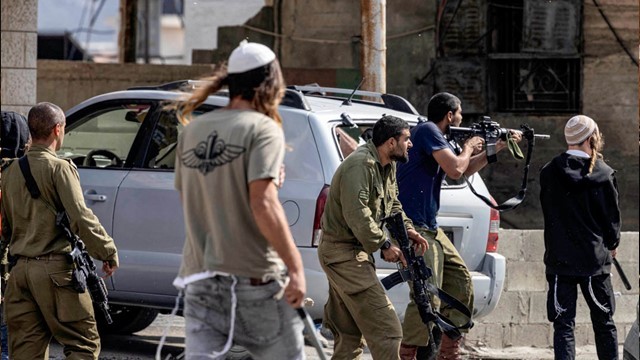
Extremist Israeli settlers have attacked Palestinian villages in the occupied West Bank, setting fire to property and spraying racist slogans on walls early Sunday. Gadi Eisenkot, an opposition leader tasked with forming Israel's next government, condemned the attacks as “Jewish terrorism”.
According to Reuters, settler violence in the West Bank has intensified since Hamas's October 2023 attack on Israel from Gaza. The latest incidents come amid political uncertainty in Israel, following Prime Minister Benjamin Netanyahu's loss of a parliamentary majority in elections held nearly a month ago.
Opposition leader Eisenkot has been tasked with forming a new government, but faces significant political challenges.
Reuters journalists found several Palestinian vehicles burned in villages near Ramallah. Racist slogans, including “Revenge” and “Death to Arabs”, had been spray-painted on walls. No group immediately claimed responsibility for the attacks, and there were no immediate reports of casualties.
Condemning the incidents as “Jewish terrorism”, Eisenkot said extremist groups setting fire to cars and homes were undermining regional stability, endangering lives and seriously damaging Israel's national security and international relations.
He also criticised the policies of two far-right ministers in Netanyahu's cabinet, Itamar Ben-Gvir and Bezalel Smotrich, saying their policies had brought the region to the brink of chaos. He accused the authorities of failing to take effective measures to address the crisis.
Netanyahu did not immediately comment on the attacks.
Israeli Foreign Minister Gideon Sa'ar, however, condemned the violence, describing the perpetrators as a small group of extremists whose actions contradicted Israel's values.
He said such individuals did not represent law-abiding Israeli citizens in Judea and Samaria, the biblical names used by Israel for the West Bank.
Speaking at the ELNET conference in Jerusalem, Sa'ar said Israeli authorities were determined to enforce the law against extremist violence.
Meanwhile, various United Nations agencies and most countries consider Israeli settlements in the West Bank illegal under international law. The continued expansion of these settlements is widely viewed as undermining the prospects of establishing an independent Palestinian state. Israel disputes this position.
Israeli police said an investigation into the attacks had been launched. The military also condemned the violence.
In a statement, the Israeli military said troops and police personnel had been dispatched to Deir as-Sudan, Deir Abu Mashal, Kafr Malik and at-Tuwani after receiving reports and video footage showing vehicles being set on fire and racist slogans being painted on walls.
Responding to Eisenkot's remarks in a post on X, Ben-Gvir accused him of effectively surrendering to Arab political parties, whose support may be necessary to form a new government.
Smotrich, meanwhile, has consistently supported expanding Israeli settlements in the West Bank and called for the territory to be annexed to Israel.
Yousef Jabarin, head of the Joint List, the largest Arab political alliance in Israel's parliament, said the attacks were a direct consequence of the deepening occupation and government policies that had made violence against Palestinians an everyday occurrence.
He also blamed Ben-Gvir and Smotrich for encouraging and supporting such violence.
Netanyahu lost his parliamentary majority in the October 27 election, although no other political bloc secured a clear majority to form a government.
As a result, members of Israel's parliament were sworn in on November 10 without a new government in place.
President Isaac Herzog subsequently tasked Eisenkot, leader of the centre-right Yashar party, with forming the next government. Netanyahu continues to serve as caretaker prime minister.
If Eisenkot fails to form a national unity government with Netanyahu, he may have to rely on support from Arab parties to secure a majority in the 120-member Knesset.
If no political leader succeeds in forming a government, Israel could face another election next year.
The latest settler attacks have further intensified political tensions, placing the issue of Palestinian rights, settlement expansion and Israel's internal political divisions at the centre of the country's ongoing government formation process.