২২ আশ্বিন ১৪৩৩



BBC Report: The Path that Led Tarique Rahman to BNP's Top Leadership
26 December 2025 07:12 AM
NEWS DESK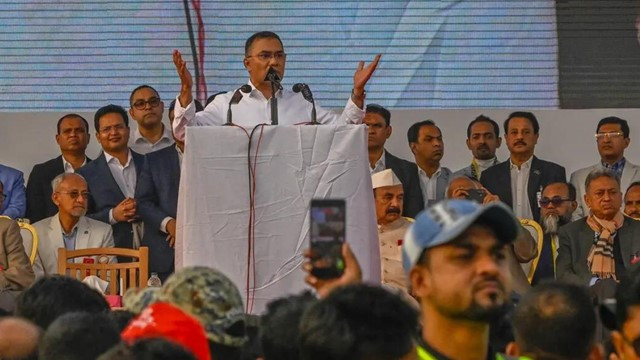
Tarique Rahman, acting chairman of the Bangladesh Nationalist Party (BNP), returned to Bangladesh on Thursday after spending more than 17 years in political exile in London, bringing an end to internal and external uncertainties surrounding his party.
Political analysts say his return, long awaited by party leaders, activists, and supporters, is seen as a moment of revival for BNP—a chance to rebuild and strengthen the party under direct leadership after navigating a challenging political landscape for decades.
Tarique Rahman, the eldest son of late President Ziaur Rahman and former Prime Minister Khaleda Zia, was born on November 20, 1965. He began his education at BAF Shaheen College, Dhaka, and later enrolled in the Department of International Relations at the University of Dhaka in the 1980s. During the Liberation War period, his family was placed under house arrest, including Tarique and his late brother Arafat Rahman.
He formally entered active politics in 1988 as a member of the Bogura District BNP’s Gabtali Upazila unit and participated alongside his mother in movements against military ruler Hussain Muhammad Ershad. His active political role within BNP deepened during the 1991 parliamentary elections when he supported Khaleda Zia’s campaigns.
Political analysts note that Tarique Rahman’s influence grew significantly during the 2001 general elections, when BNP-led coalition secured a two-thirds majority. He played a key role in election strategy and operations, often coordinating from BNP headquarters, Hawa Bhaban. Analysts point out that after the 2007 military-backed caretaker government and subsequent political turmoil, he faced arrests, harassment, and threats, which eventually forced him into exile in London in September 2008.
Despite being abroad, Tarique Rahman led the party virtually, especially after Khaleda Zia was imprisoned in 2018 following corruption convictions, and he has been serving as the acting chairman since then. He has also faced numerous legal challenges, including the 2004 grenade attack case and other politically motivated cases during the Awami League government.
Political experts highlight that Tarique Rahman’s leadership style closely mirrors that of his father, Ziaur Rahman, emphasizing grassroots engagement and strategic party organization. According to Dr. Ziauddin Haider, a longtime advisor to the BNP chairperson, Tarique Rahman has combined field-level engagement with policy-oriented decision-making, making him well-positioned to lead both the party and, potentially, the country in the future.
Analyst Mahfuz Ulla notes that Tarique Rahman’s return symbolizes “rising from the ruins,” restoring hope among BNP supporters and consolidating the party’s internal structure after years of uncertainty. Analysts also believe that his experience navigating political conflicts, repression, and party organization gives him the perspective needed to strengthen BNP’s role in Bangladesh’s national politics.
With his return, Tarique Rahman is expected to actively lead BNP in the upcoming 13th parliamentary elections scheduled for February 12, under the interim government led by Nobel laureate Dr. Muhammad Yunus. This marks the first time he will contest parliamentary elections personally, potentially shaping the party’s future trajectory and influence in Bangladesh’s political landscape.