১৭ আশ্বিন ১৪৩৩



Bangladesh Calls for Stronger Trade, Investment Ties with India
19 August 2026 05:08 AM
NEWS DESK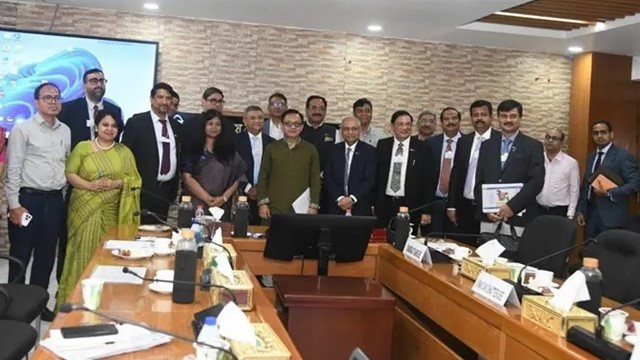
Bangladesh has emphasized the need to transform its geographical proximity with India into greater economic benefits by expanding bilateral trade, investment, and industrial cooperation.
Speaking at a meeting with a delegation from the Confederation of Indian Industry (CII) at the Secretariat on Tuesday, Commerce Minister Khandaker Abdul Muqtadir said that removing trade barriers, restoring a normal trading environment, easing visa procedures, and increasing private-sector engagement are essential for building a long-term economic partnership between the two neighboring countries.
The CII delegation was led by its Director General, Chandrajit Banerjee. Discussions focused on bilateral trade and investment, existing challenges, and future areas of cooperation.
The minister said that despite differences in size, population, and economic scale, Bangladesh and India share unique geographical advantages that create significant opportunities for closer collaboration. He highlighted Bangladesh’s strategic location and its connectivity with India’s northeastern states as key factors that could boost trade, transportation, and investment.
Referring to South Asia’s large combined economy, the minister noted that intra-regional trade remains relatively low. He said stronger economic connectivity would create new opportunities for industrialization, investment, and employment across the region.
Addressing recent trade restrictions between the two countries, Muqtadir stressed the need for dialogue to restore bilateral trade to its previous normal level. He expressed optimism that meaningful progress could be achieved within the next few months.
Visa-related challenges for businesspeople and professionals also featured prominently in the discussions. The minister said requiring frequent travelers to apply for new visas every few months is impractical and called for greater cooperation to introduce longer-term visa arrangements.
During the meeting, the CII proposed the establishment of two joint task forces to deepen cooperation. One would focus on promoting private investment and public-private partnerships (PPP) in infrastructure, while the other would support collaboration in emerging industries such as semiconductors, green hydrogen, battery storage, and data centers.
The Indian business body noted that India invested nearly ₹25 trillion in infrastructure last year, with a significant contribution from the private sector. It suggested that Bangladesh could attract more domestic and foreign institutional investment by drawing on India’s experience.
Both sides also highlighted the importance of strengthening Bangladesh’s local manufacturing capacity. Indian business representatives said many capable local industries are underperforming due to operational challenges, adding that expanding domestic production would reduce import dependence and accelerate project implementation.
Citing a joint venture with Energypac, one representative noted that many products are still imported despite the availability of local manufacturing capacity. He said transporting goods through land ports can take up to 40–45 days, a challenge that could be eased by revitalizing local industries.
The CII also expressed interest in investing in Bangladesh’s fast-moving consumer goods (FMCG) sector, including plans to establish a modern integrated manufacturing facility near Dhaka to produce soap, home-care insecticides, fragrances, and other consumer products. It also called for a stronger regulatory framework to ensure quality control of unregistered products.
In addition, the delegation urged Bangladesh to review its tariff structure to encourage the adoption of energy-efficient industrial technologies. According to CII representatives, advanced steam-related technologies could reduce gas consumption by 10–35 percent in the textile, ready-made garment, and food processing industries, although existing tariff disparities remain a barrier.
The Indian business body further proposed creating internship opportunities for Bangladeshi youth in Indian companies and enhancing cooperation to resolve visa issues faced by Bangladeshi engineers seeking employment in third countries.
Both sides agreed that beyond formal discussions, concrete initiatives, stronger business-to-business engagement, and institutional mechanisms will be essential for making Bangladesh-India economic relations more effective and mutually beneficial.