১২ আশ্বিন ১৪৩৩



China Invests Heavily in Caspian Trade Corridor to Strengthen Europe Route
30 June 2026 05:06 AM
NEWS DESK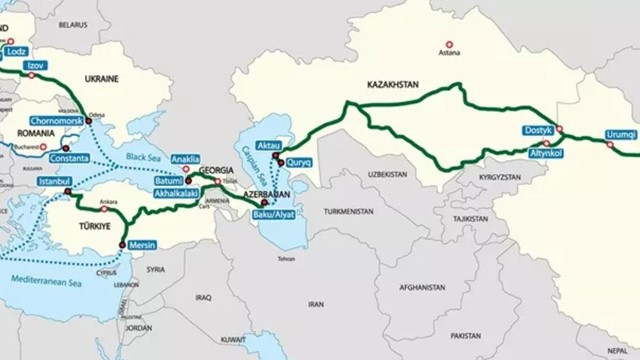
China has made significant investments in a new transport corridor across the Caspian Sea, aiming to establish a faster and more secure trade route to Europe while bypassing Russia and conflict-prone regions in the Middle East, analysts say.
State-owned Chinese companies have invested hundreds of millions of dollars in developing the 4,750-kilometer Middle Corridor, a route that connects China with Europe through Kazakhstan, the Caspian Sea, Azerbaijan, Georgia, and Türkiye.
According to the Georgia-based intergovernmental program Transport Corridor Europe-Caucasus-Asia (TRACECA), China has provided nearly $70 million in grant assistance for the development of Baku Port in Azerbaijan, along with equipment worth approximately $2 million. Chinese firms are also involved in the construction of a new seaport in Aktau, Kazakhstan, on the eastern shore of the Caspian Sea.
Also known as the Trans-Caspian International Transport Route (TITR), the corridor combines ports, railways, and highways into an integrated transport network.
A Turkish diplomatic source told the South China Morning Post that once the corridor becomes fully operational, cargo shipments from China could reach Europe in 15 to 18 days, significantly faster than the 45 to 60 days typically required via traditional maritime routes.
The European Union is currently China's largest export market, making improved transport connectivity strategically important for both sides.
Despite its potential, experts say the corridor still faces significant challenges. Alexander Cooley, a professor of political science at Barnard College in New York, noted that the route's cargo capacity remains well below that of conventional sea lanes, while transportation costs per unit are relatively higher.
He also pointed to several logistical obstacles, including expanding Caspian Sea shipping capacity, modernizing ports, and addressing differences in railway gauges across participating countries.
However, Cooley said China possesses both the financial resources and technical expertise needed to overcome these challenges and further develop the corridor.
The Middle Corridor has gained increasing strategic importance as the traditional overland route linking China to Europe through Russia—stretching roughly 10,000 kilometers—has become more complicated due to Western sanctions related to the war in Ukraine. At the same time, ongoing instability in the Middle East and piracy threats along parts of Africa's coastline have increased the risks associated with conventional maritime shipping routes, making the Caspian corridor an increasingly attractive alternative.