[email protected]
রবিবার, ১ নভেম্বর ২০২৬
১৭ কার্তিক ১৪৩৩
১৭ কার্তিক ১৪৩৩

Sunday, 1st November 2026


Canada and European Union Announce New Alliance to Reduce Dependence on the United States
31 October 2026 23:10 PM
NEWS DESK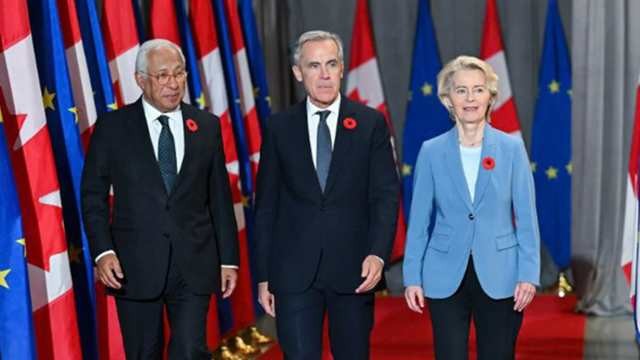
Canada and the European Union (EU) have announced the formation of a new alliance aimed at addressing global political uncertainty and reducing reliance on the United States.
Named the “Alliance for the Future,” the new partnership is also inviting other like-minded countries that share similar values to join the initiative.
Canadian Prime Minister Mark Carney and European Commission President Ursula von der Leyen announced the partnership on Friday following a two-day summit in Montreal, Canada.
The leaders said deeper cooperation between Canada and the EU’s 27 member states could create unprecedented stability and new opportunities.
Carney said their societies were facing growing challenges, including the climate crisis, the erosion of democratic values, and the use of trade as a political weapon. He stressed the need for like-minded countries to work together to address these challenges.
During the summit, Canada pledged to contribute to the European Union’s €90 billion loan program to support Ukraine. The two sides also discussed plans to develop a coordinated market worth tens of billions of dollars, reduce barriers to trade and travel, and expand educational exchange opportunities.
Against the backdrop of escalating trade tensions with the United States, Carney has been seeking new international partners. Canada is particularly interested in reducing its dependence on American companies in critical sectors such as defense technology and artificial intelligence (AI).
Concerns have reportedly intensified following restrictions on the performance of Starlink and Starshield services in Ukraine.
In this context, Carney highlighted a potential merger between Canadian AI company Cohere and Germany’s Aleph Alpha as an important step toward developing alternative technological capabilities.
The proposed new company will have headquarters in Berlin and Toronto. The Canadian government has announced plans to invest up to C$1.6 billion in the initiative. The two sides have also reached an agreement on Canada's participation in Europe's supercomputing network.
The possibility of granting Canada an “associate membership” status in the European Union was also discussed. However, the leaders said the structure and scope of such membership would be finalized at a summit in 2027. Several EU member states had previously raised objections to the proposal.
European Council President António Costa described Canada as the “most European” country outside Europe.
Meanwhile, the summit has sparked political controversy in Canada's Quebec province. Paul St-Pierre Plamondon, leader of the separatist Parti Québécois and Quebec's premier, did not attend the event. He expressed frustration after Ottawa reportedly denied him the opportunity to address the gathering publicly.
Advertisement