৯ আশ্বিন ১৪৩৩



Rare Book Sellers Fear AI Firms Could Destroy Valuable Books for Model Training
11 August 2026 06:08 AM
NEWS DESK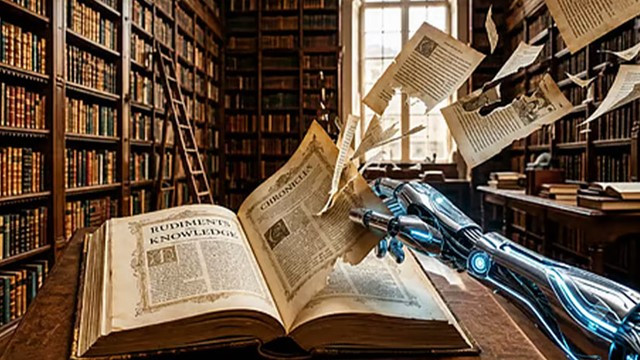
Rare book dealers and antiquarian booksellers are raising concerns that artificial intelligence companies could be contributing to the destruction of printed books in order to obtain data for training large language models, prompting fears over the loss of culturally and historically significant works.
The concerns have intensified following a U.S. copyright lawsuit against AI company Anthropic, whose court filings revealed earlier this year that the company had used a process known as "destructive scanning." Under the method, printed books were purchased, their bindings cut off so pages could be scanned more efficiently, and the remaining physical copies discarded after digitization. A U.S. judge later ruled that the practice was legal under copyright law as a "transformative use."
For rare book dealers such as Tim White, owner of Melbourne's Books for Cooks, the issue goes beyond the text contained in a book.
"Sometimes a book tells you more than what's written inside it," White said while preparing his collection for Melbourne's Rare Book Fair. "We deal with books that have stories of their own."
White said booksellers often value the physical object itself—its history, provenance, and uniqueness—as much as its contents.
Industry concerns have grown amid reports that AI companies are acquiring large quantities of books through intermediaries. Several Australian booksellers told The Guardian Australia they had recently received unusual bulk purchase orders from Canadian company Zoom Books, which describes itself as a book recycling business.
According to sellers, the orders appeared highly unusual. Buyers paid full price without negotiating, covered shipping costs, and selected books seemingly at random—including inexpensive paperbacks, decades-old technical manuals, poetry collections, and local history titles.
Delfina Manor, owner of Good Reading Secondhand Books in Victoria, said Zoom Books ordered around three boxes containing 30 to 40 books in a single purchase.
"They paid upfront and didn't question the postage costs," she said. "But finding, packing and checking every book was exhausting."
John Sainsbury, owner of Melbourne's Sainsbury's Books, reported receiving similar orders for books ranging from engineering manuals and cycling histories to poetry collections and local history publications.
While some booksellers believe Zoom Books may simply be purchasing stock for resale, others remain skeptical because of the unusual buying patterns.
The possibility that books might ultimately be destroyed for AI training has sparked ethical concerns, particularly when rare or unique works are involved.
"If it's a $20 book with half a million copies in circulation, that's one thing," White said. "But if it's a unique copy with a story that makes it special, destroying it would be devastating."
Bookseller Nick Dowse, who operates Grant's Bookshop with his wife Jenny and estimates they have around 500,000 books in storage, said he would hesitate to sell a one-of-a-kind volume if he knew it would be destroyed.
"If someone told me it was the only known copy and they wanted to cut it apart, I'd probably refuse to sell it," he said.
The practice of dismantling books for profit predates the AI industry. Some dealers have long purchased rare books only to separate and sell individual illustrations or prints.
Gwyneth Todd, a rare book dealer at Chatelaine Books, said seeing books broken apart after sale was deeply upsetting.
"To me, a book is much more than just an object," she said, adding that she carefully vets buyers to ensure important works end up in responsible hands.
Anthropic has denied purchasing books from Zoom Books. A company spokesperson acknowledged that acquiring books to train large language models is common across the AI industry but said Anthropic sources books from mainstream commercial markets and does not destroy rare or antiquarian books as part of its data collection process.
Zoom Books has also denied digitizing books itself. In a statement to The Guardian Australia, the company said it acquires second-hand books and resells them intact whenever possible.
"Our priority is always to recirculate books," a spokesperson said. "When a book can no longer be passed on to a new reader, we recycle it responsibly."
However, the company declined to say whether books it purchases are later sold to AI companies for destructive scanning, citing confidentiality clauses in its commercial agreements.