৩০ ভাদ্র ১৪৩৩



Israel Would Not Exist Without US Support, Declares President Trump
16 June 2026 19:06 PM
NEWS DESK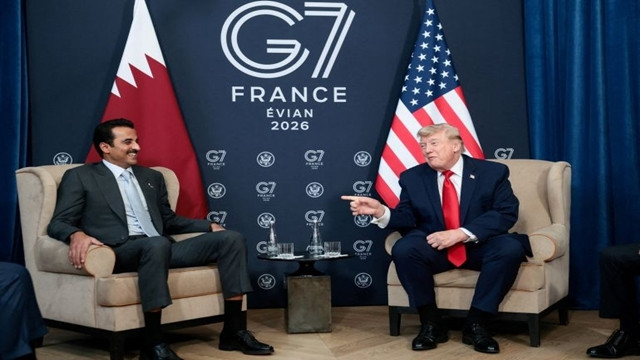
President Donald Trump asserted that Israel’s survival would have been impossible without the unwavering support of the United States, credit his administration’s decisive actions for placing the nation in its current position of strength.
However, despite highlighting this ironclad alliance, the US President issued a stern warning to Israeli Prime Minister Benjamin Netanyahu, demanding more responsible conduct regarding military operations in Lebanon. Trump made these critical remarks during a bilateral meeting with the Amir of Qatar, Sheikh Tamim bin Hamad Al Thani, on the sidelines of the G7 Summit in Évian, France.
According to diplomatic sources, President Trump emphasized that no other US president would have been prepared to take the historic and bold steps he enacted to guarantee Israel's security. Yet, while maintaining that his relationship with Netanyahu remains strong, Trump openly criticized the recent trajectory of Israeli military campaigns. He explicitly noted his intense disapproval of the Israeli airstrikes on Beirut, which were executed a mere two hours before the finalization of the landmark peace accord with Iran, stating he immediately conveyed his dissatisfaction to Tel Aviv.
Expressing deep concern over the mounting civilian casualties resulting from Israel's prolonged offensive against Hezbollah, the US President cautioned against indiscriminate tactics. He argued that targeting key operatives does not justify the annihilation of entire residential structures. Trump pointed out that such apartment complexes house hundreds of innocent civilians who have no affiliation with Hezbollah, urging for a more precise and humanitarian approach to warfare.
Offering an alternative strategic roadmap for regional security, Trump suggested that Syria should be given the leverage to handle the Hezbollah threat within its sphere. He noted that Damascus could potentially manage the containment process more effectively than Israel. Analysts view Trump's calculated rhetoric—balancing traditional alliance commitments with public rebukes over civilian casualties—as a significant tactical shift in Washington's Middle East diplomacy amid intensifying international scrutiny.