[email protected]
বুধবার, ১৬ সেপ্টেম্বর ২০২৬
৩১ ভাদ্র ১৪৩৩
৩১ ভাদ্র ১৪৩৩

Tuesday, 15th September 2026


U.S. Confirms Deployment of Weapons in Space to Defend Against Attacks
15 September 2026 23:09 PM
NEWS DESK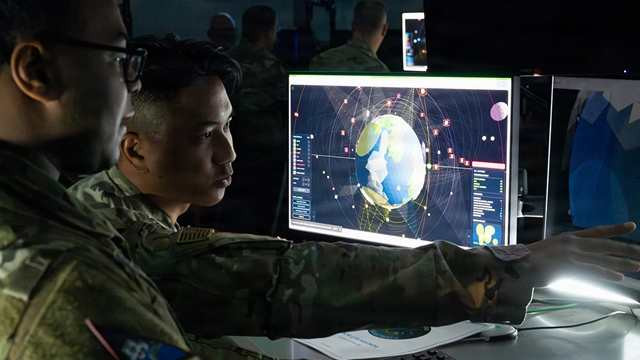
The United States has deployed weapons in space that are intended to protect U.S. military forces from attacks by adversaries, Air Force Secretary Troy Meink has said, marking the first time Washington has publicly acknowledged such a capability.
Meink’s remarks are being viewed as a potential message to countries that could pose a threat to U.S. space assets.
Speaking Monday at the annual Air, Space and Cyber Conference organized by the Air & Space Forces Association in National Harbor, Maryland, Meink said the United States was prepared to respond to threats wherever they emerged.
“That is why we now have space-control weapons” capable of protecting joint U.S. forces from attacks, he said.
Meink did not disclose what types of weapons had been deployed or how many were involved. When pressed for further details, he declined to provide additional information. It also remains unclear when the weapons were placed into orbit.
Growing Competition in Space
President Donald Trump established the U.S. Space Force in 2019 under the Department of the Air Force, describing it as a historic step toward strengthening America’s defense capabilities in space.
At the same time, the strategic competition in space has intensified as China and Russia seek to challenge U.S. military dominance in the domain.
According to the U.S. Space Force, China is developing and operating space and counterspace capabilities as part of its broader military modernization strategy. Russia, meanwhile, views space as a potential battlefield and considers dominance in space an important factor in future conflicts.
U.S. military officials have for years warned that both countries are testing new offensive space capabilities.
Washington has pointed to Russian missions involving satellite constellations, saying such activities could help Moscow develop the ability to demonstrate offensive and defensive tactics in a future conflict. U.S. officials have also raised concerns about China’s development of nuclear-capable hypersonic missiles.
Concerns Over Space-Based Nuclear Weapons
In 2024, CNN reported that U.S. intelligence agencies believed Russia had been pursuing a space-based nuclear weapon.
The weapon was reportedly designed to generate a powerful energy wave or electromagnetic pulse capable of disabling large numbers of commercial and government satellites. Moscow has denied the allegations.
The use of such a weapon could have far-reaching consequences. Satellites used for weather forecasting and disaster response could be affected, along with global navigation systems that support banking, shipping, ride-sharing services, ambulance operations and numerous other essential activities.
Meink said maintaining U.S. dominance was important not only in the air but also in space.
“We have to take the steps necessary so that when we are threatened, we are able to respond,” he said.
International Treaty Leaves Room for Conventional Weapons
The 1967 Outer Space Treaty prohibits the deployment of nuclear weapons and other weapons of mass destruction in Earth’s orbit. However, it does not explicitly ban conventional weapons in space.
The treaty also does not prohibit the use of conventional weapons launched from Earth against objects or facilities in space, leaving room for differing interpretations of what activities are permitted.
Last December, Trump issued an executive order describing U.S. space superiority as a measure of “national vision and resolve.” The order emphasized the development of next-generation missile-defense technologies and the need to ensure U.S. capabilities against a range of threats, including the potential deployment of nuclear weapons in space.
Space Interceptors and the ‘Golden Dome’
The latest development also appears connected to Trump’s proposed “Golden Dome” missile-defense system. Modeled in part on Israel’s Iron Dome, the proposed system is intended to give the United States the ability to intercept missiles launched from anywhere in the world, according to U.S. officials.
Washington has not yet provided detailed information about how the system would be built or how it would operate. Trump has expressed hope that the system will be completed by 2028.
CNN previously reported, citing two sources familiar with the matter, that the Pentagon had scheduled the first major test of the system for shortly before the 2028 election.
In his remarks Monday, Meink said the U.S. space-based interceptor program had progressed from an initial agreement to “flight-ready hardware” in less than a year.
He provided no further details about the program, including the nature, number or location of the planned interceptors.
Advertisement