২৬ আশ্বিন ১৪৩৩



China-Myanmar-Bangladesh Economic Corridor: Opportunity or Strategic Challenge for Dhaka?
13 July 2026 09:07 AM
NEWS DESK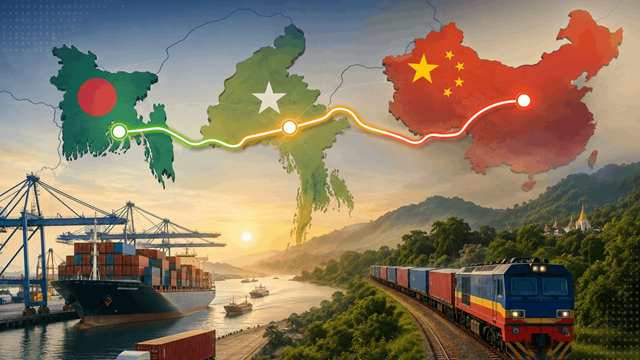
Following Prime Minister Tarique Rahman's recent visit to China, discussions have intensified in Dhaka and Beijing over the proposed China-Myanmar-Bangladesh Economic Corridor (CMBC).
The project is being viewed as a potential gateway for greater regional connectivity, trade, and investment among China, Myanmar, and Bangladesh. However, analysts caution that Bangladesh must carefully assess the economic, security, and geopolitical implications before giving final approval to the initiative.
The CMBC proposal gained renewed attention after Prime Minister Tarique Rahman's visit to China in June. During the visit, Dhaka and Beijing issued their third joint communiqué since establishing diplomatic relations in 1975. One of the key issues discussed was the proposed economic corridor, which aims to connect China's southwestern Yunnan province, particularly the city of Kunming, with Bangladeshi ports through Myanmar via road and rail networks.
For China, the corridor carries major strategic importance. It would provide a shorter route to the Indian Ocean and reduce Beijing's dependence on the strategically sensitive Malacca Strait. For Bangladesh, the project could bring improved transportation links, increased foreign investment, expanded trade opportunities, and new employment prospects.
However, the initiative is not entirely new. It is a modified version of the proposed Bangladesh-China-India-Myanmar (BCIM) Economic Corridor, first introduced in 1999. India later stepped away from the project amid concerns over China's Belt and Road Initiative (BRI) and Beijing's growing regional influence. China is now pursuing the corridor with Myanmar and Bangladesh without India's participation.
Economic Opportunities and Trade Imbalance
Experts say the corridor presents significant opportunities for Bangladesh but also places the country in a complex strategic position. Dhaka must maintain a balance in its relations with China, India, the United States, and other major partners.
China has shown strong interest in advancing the project. Chinese Ambassador to Bangladesh Yao Wen recently said Chinese officials were preparing a roadmap for the corridor. Beijing is also maintaining contacts with various groups in Myanmar to protect its strategic and economic interests there.
However, Bangladesh's economic relationship with China remains heavily imbalanced.
In 2024, Bangladesh imported approximately $22.8 billion worth of goods from China, while exports to China stood at only around $1.2 billion, creating a trade deficit of nearly $21.7 billion.
Economists argue that improved transportation alone will not solve this imbalance. Without strengthening domestic industries and expanding competitive export products, Bangladesh could risk becoming an even larger market for Chinese goods rather than a regional production hub.
Bangladesh's export earnings remain heavily dependent on ready-made garments and labor-intensive industries, while China maintains global dominance through advanced technology, integrated supply chains, and large-scale manufacturing.
Experts also note that infrastructure development is only one part of economic transformation. Although Bangladesh has made significant progress through projects such as the Padma Bridge, major challenges remain in logistics, warehousing, customs procedures, and multimodal transportation.
Without addressing these internal weaknesses, Bangladesh could become merely a transit route rather than a regional trade and manufacturing center.
Myanmar's Security Situation and Rohingya Crisis
The biggest challenge to implementing the corridor is Myanmar's security environment. The proposed route would pass through Myanmar's conflict-affected Rakhine State, where a civil war has continued since the 2021 military coup.
A significant portion of the proposed route is currently under the influence or control of the Arakan Army, creating uncertainty for any long-term infrastructure project.
The Rohingya crisis adds another layer of complexity. Bangladesh currently hosts around 1.2 million Rohingya refugees. Analysts emphasize that any regional connectivity initiative must not undermine efforts toward the safe, voluntary, and dignified repatriation of Rohingya refugees.
Some experts warn that infrastructure projects passing through conflict zones could unintentionally create new sources of revenue for armed groups, potentially strengthening them. They argue that a comprehensive security assessment is essential before any final agreement.
Geopolitical Concerns Surrounding the Corridor
The CMBC project also carries significant geopolitical implications.
India is closely watching China's growing presence near its sensitive northeastern region and the strategic Siliguri Corridor, often referred to as India's "Chicken's Neck."
Meanwhile, Washington has encouraged Bangladesh to strengthen economic ties while maintaining strategic balance in its foreign relations.
Analysts advise that Bangladesh should avoid becoming part of a geopolitical rivalry and instead evaluate the project solely based on national interests.
They point to examples such as the China-Laos Railway, the China-Pakistan Economic Corridor (CPEC), and Sri Lanka's Hambantota Port as lessons showing that infrastructure alone does not guarantee economic success. Transparent financing, careful feasibility studies, strong institutions, and a competitive domestic economy are equally important.
What Should Bangladesh Do?
Experts suggest that Bangladesh should move cautiously and gradually rather than committing immediately to a high-risk mega project.
They recommend prioritizing smaller, practical connectivity projects while keeping the CMBC as a long-term strategic goal. Bangladesh should also focus on attracting Chinese investment in export-oriented industries rather than increasing dependence on imports.
At the same time, Dhaka should establish clear national policies regarding debt sustainability, environmental protection, labor standards, and security concerns to ensure future connectivity projects serve the country's long-term interests.
Overall, the China-Myanmar-Bangladesh Economic Corridor has the potential to strengthen Bangladesh's position as a regional connectivity hub. However, its success will depend not only on building roads and railways but also on whether Bangladesh can develop a stronger, more competitive, and resilient economy capable of maximizing the benefits while managing the risks.