[email protected]
বৃহঃস্পতিবার, ৮ অক্টোবর ২০২৬
২৩ আশ্বিন ১৪৩৩
২৩ আশ্বিন ১৪৩৩

Thursday, 8th October 2026


Bangladesh Eyes Alternative Financing, $2 Billion Hong Kong Fund, Finance Minister Says
23 August 2026 11:08 AM
NEWS DESK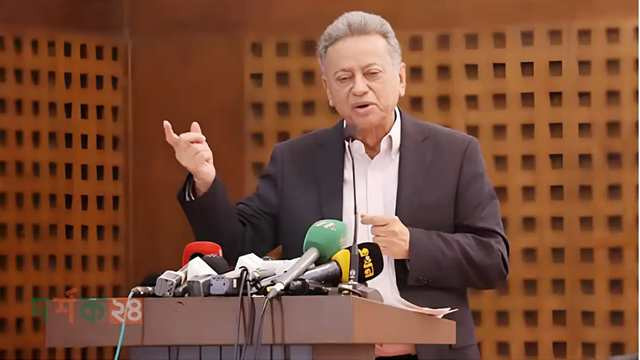
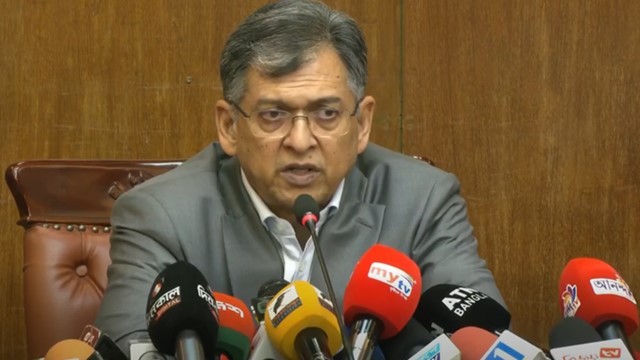
Bangladesh is looking beyond traditional lenders such as the International Monetary Fund (IMF) and the World Bank as it seeks alternative sources of financing and aims to strengthen the country's capital market, Finance Minister Amir Khosru Mahmud Chowdhury said on Saturday.
Speaking at a seminar in Motijheel organised by the Dhaka Chamber of Commerce and Industry (DCCI), the minister said the government was planning a $2 billion dedicated fund for Bangladesh in Hong Kong and was also considering issuing Panda bonds and Samurai bonds in international markets.
He said the government had appointed qualified and professional individuals to the Bangladesh Securities and Exchange Commission (BSEC) to restore investor confidence in the capital market, adding that positive signs were already visible.
The seminar, titled “Half-Yearly Economic Situation of FY2026: Perspective of Fiscal and Monetary Policy and Private Sector Expectations,” brought together business leaders and leading economists.
Focus on Private Sector and Investment
Responding to concerns raised by business leaders and economists, Khosru said the government remained committed to a development strategy centred on the private sector.
He said the BNP-led government had often taken responsibility for running the country during periods of economic difficulty, bringing both challenges and opportunities. Nevertheless, he said, the government was working to build a sustainable economic ecosystem.
The minister stressed that stronger confidence among domestic investors was essential for attracting foreign investment.
To make doing business easier, the government is placing particular emphasis on deregulation. A special committee and a dedicated website are being launched to allow businesses to directly report regulatory and operational problems, he said.
The government is also seeking to reduce business costs by setting specific time limits for customs clearance and the release of goods at ports.
Energy Crisis Remains a Challenge
Khosru acknowledged that longstanding problems in the energy sector could not be resolved overnight.
He said the government was pursuing both short- and long-term plans. Bangladesh has already managed to increase its fuel reserves to around one month, with a target of raising the reserve to three months.
The government is also discussing the possibility of adding multiple floating storage and regasification units (FSRUs) to address the gas shortage, while work has begun to increase domestic gas reserves, he said.
Banking Reforms and SME Support
The finance minister said there would be no political interference or politically motivated appointments in efforts to stabilise and reform the banking sector.
He said Bangladesh Bank had introduced special support packages and an easier exit policy for borrowers who had become defaulters because of circumstances beyond their control rather than through deliberate default.
Khosru also stressed that increasing the country's tax-to-GDP ratio was essential. To improve transparency and combat corruption, the government is accelerating the introduction of full automation across public services, with relevant authorities given deadlines to implement the changes.
Private Credit Growth Raises Concerns
In his keynote presentation, DCCI President Taskeen Ahmed said credit growth to the government had reached 25.9%, while private-sector credit growth stood at only 5%.
He said the combination of high inflation and sluggish private-sector lending was a concern for investment.
Ahmed called for uninterrupted services in industrial zones, shorter export lead times and a stronger capital market to reduce businesses' dependence on bank financing.
He also said actual lending to the CMSME sector had reached only 16.8%, against a target of 25%. Rising business costs had pushed the sector's non-performing loan ratio to 24.1%, he said.
To address the problem, he proposed expanding access to credit through digital scoring rather than relying solely on conventional collateral-based lending, as well as creating a dedicated fund for affordable machinery.
Economists Call for Faster Reforms
PPRC Executive Chairman Hossain Zillur Rahman said harassment across various parts of the economy had become institutionalised, undermining the benefits of reform initiatives.
He said expanding the tax base and implementing economic reforms would require both reducing such harassment and demonstrating strong political commitment. He proposed establishing an Economic Reform Acceleration Unit to monitor implementation of reforms.
ICC Bangladesh President Mahbubur Rahman said inflation remained above the desired level, private-sector credit growth was at a long-term low and investment remained sluggish.
High interest rates, rising production and import costs, exchange-rate pressures and uncertainty over energy supplies have increased the cost of doing business, he said.
Mahbubur called for a stable, predictable and investment-friendly policy environment to restore private-sector confidence and improve competitiveness.
PRI Chairman Zaidi Sattar said a significant gap between policy formulation and implementation was preventing Bangladesh from achieving the desired economic outcomes. He also warned that high import duties were contributing to higher domestic prices and inflation.
CPD Distinguished Fellow Professor Mustafizur Rahman said good initiatives in the national budget were not being adequately reflected in monetary policy.
He argued that monetary policy reforms were necessary to control inflation and warned that achieving the government's revenue collection targets would be difficult without a major improvement in tax mobilisation.
Mustafizur also raised concerns that not all of the taxes paid by citizens were reaching the government treasury and urged greater caution in taking on and repaying foreign loans.
Businesses Demand Predictability
Business representatives at the seminar identified high interest rates, rising non-performing loans, heavy government borrowing from banks, energy shortages and weak logistics as major obstacles to private-sector recovery.
They argued that simply lowering interest rates would not be enough to revive investment. Reliable energy supplies, supporting infrastructure and greater certainty in business operations were also essential.
Speakers called for a more business-friendly environment, policy reforms and an end to harassment in the name of tax collection to restore momentum to the economy.
Government representatives acknowledged that the country's economic problems could not be resolved overnight but said strong measures were being taken to remove obstacles to trade and investment.
Advertisement