২ কার্তিক ১৪৩৩



Military Seizes Power in Guinea-Bissau Three Days After Election
28 November 2025 07:11 AM
NEWS DESK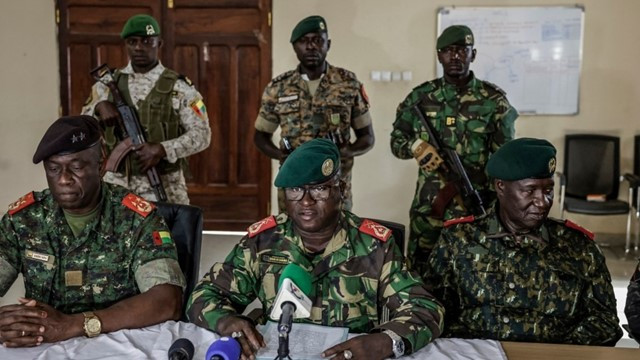
Military officers in Guinea-Bissau say they have taken "total control" of the west African country, closing its borders and suspending its electoral process three days after general elections.
Incumbent President Umaro Sissoco Embalo, who had been favoured to win Sunday's election, had also been arrested and was being held at general-staff headquarters where he was being "well treated", a military source told.
A senior officer who confirmed Mr Embalo's arrest said the chief of staff and the minister of the interior were also detained.
Two sources also told that Guinea-Bissau's main opposition leader, Fernando Dias, who was barred from last weekend's presidential election by the Supreme Court, had been arrested.
In the early afternoon, General Denis N'Canha, the head of the presidential military office, told members of the press that a command "composed of all branches of the armed forces was taking over the leadership of the country until further notice".
Speaking while seated at a table and surrounded by armed soldiers, General N'Canha said he had uncovered a plan to destabilise the country that involved drug lords and "the introduction of weapons into the country to alter the constitutional order".
In addition to halting "the entire electoral process", he said military forces had suspended all media programming, closed land, air, and sea borders, and imposed a mandatory curfew.
The announcement followed heavy gunfire that rang out near the presidential palace earlier in the day, with men in military uniform taking over the main road leading to the building.
Guinea-Bissau's National Electoral Commission (CNE) was additionally attacked by unidentified armed men on Wednesday, commission communications official Abdourahmane Djalo told.
Mr Embalo and Mr Dias had already each declared victory in the presidential race, with official provisional results expected today.
More than 6,780 security forces, including from the Economic Community of West African States (ECOWAS) Stabilisation Force, were deployed for Guinea-Bissau's vote and the post-election period.
The tumultuous west African country has experienced four coups since gaining independence, as well as multiple attempted coups.
The country's last presidential vote in 2019 was marked by a four-month post-election crisis as both main candidates claimed victory.
The election pitted Mr Embalo against Domingos Simoes Pereira, the candidate from the country's main opposition party PAIGC, which secured Guinea-Bissau's independence from Portugal in 1974.
The country's 2025 election notably excluded PAIGC and Pereira, who were struck from the final list of candidates and parties by the Supreme Court, which said they had filed their official applications too late.
In 2023, Mr Embalo dissolved the legislature — which was dominated by the opposition — and has since ruled by decree.
The opposition says PAIGC's exclusion from the presidential and parliamentary elections amounts to "manipulation" and maintains that Mr Embalo's term expired on February 27, five years to the day after his inauguration.
Guinea-Bissau is among the world's poorest countries and is also a hub for drug trafficking between Latin America and Europe, a trade facilitated by the country's long history of political instability.