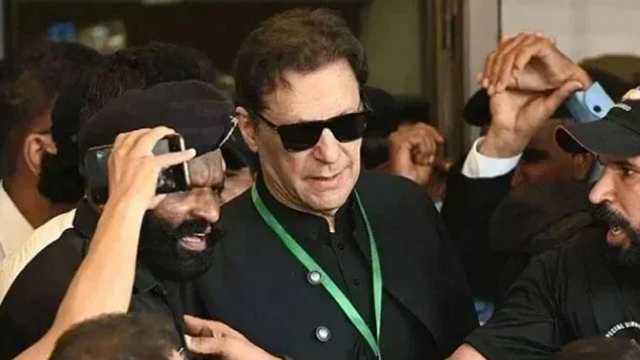
Pakistan Tehreek-e-Insaf (PTI) Secretary General Salman Akram Raja has claimed that former Pakistani Prime Minister Imran Khan lost vision in one eye after allegedly being subjected to mistreatment in prison.
Speaking to journalists outside the Supreme Court of Pakistan in Islamabad on Wednesday, Raja said that Imran Khan has been imprisoned for nearly 1,000 days and continues to be deprived of basic rights while in custody.
Earlier, on April 28, Khan reportedly received his fourth intravitreal eye injection at the Pakistan Institute of Medical Sciences (PIMS).
Raja alleged that Khan’s health remains in serious danger inside prison. He also claimed that strict restrictions have been imposed on meetings between Khan and his wife, Bushra Bibi. According to him, despite court orders, family members and associates are not being allowed to meet the former prime minister.
In a report submitted to the Supreme Court, Khan’s lawyer and court-appointed amicus curiae, Salman Safdar, stated that the former premier is suffering from a serious eye condition known as Central Retinal Vein Occlusion (CRVO). The disease occurs when the main vein responsible for draining blood from the retina becomes blocked. CRVO is commonly associated with conditions such as high blood pressure, diabetes, high cholesterol, and heart disease.
Salman Akram Raja further alleged that authorities are preventing Khan from signing legal documents and limiting access to only a small number of approved visitors. He claimed that even Khan’s sisters have been denied permission to meet him.
Commenting on Pakistan’s broader political situation, Raja warned that the country’s economy is nearing collapse and said that Khyber Pakhtunkhwa is “drenched in blood.” He also accused the authorities of undermining the independence of the judiciary.
Meanwhile, Chinese President Xi Jinping had earlier outlined China’s four “red lines” during talks with former U.S. President Joe Biden in 2024. Beijing has stated that while it remains open to building a stable and constructive relationship with the United States, such ties must be based on respect for China’s sovereignty and internal system.
Analysts believe that the evolving geopolitical climate, along with high-level diplomatic engagements and the involvement of major global technology leaders, could reshape the future strategic relationship between the world’s leading powers.