১০ কার্তিক ১৪৩৩



Report by Reuters
Islamist Leader Emerges as Key Contender Ahead of Bangladesh’s 13th Parliamentary Election
11 February 2026 06:02 AM
NEWS DESK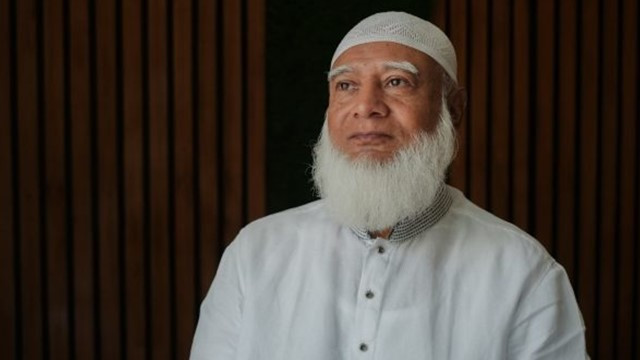
Bangladesh is set to hold its 13th national parliamentary election on February 12, marking the country’s first general election since former Prime Minister Sheikh Hasina fled to India following a Gen-Z–led mass uprising in July–August 2024.
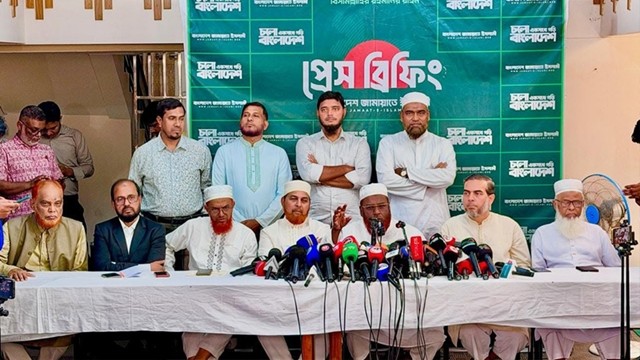
The election is expected to feature a fierce contest primarily between the Bangladesh Nationalist Party (BNP) and Bangladesh Jamaat-e-Islami. However, Jamaat — long a marginal force in Bangladeshi politics — has seen a dramatic resurgence, with its Ameer, Dr. Shafiqur Rahman, emerging as a serious contender for the post of prime minister.
According to a report by British news agency Reuters, posters and billboards featuring the white-bearded Islamist leader have appeared across key locations in the capital, Dhaka, urging voters to bring the country’s “first Islamist government” to power.
At 67, Dr. Shafiqur Rahman was previously little known beyond Islamist circles. But as party chief, he has now positioned himself as one of the most prominent figures in the prime ministerial race. Analysts say Jamaat is poised to mount a strong challenge against its former ally and now main rival, the BNP.
Bangladesh, home to about 175 million people, is approximately 91% Muslim, making it one of the world’s largest Muslim-majority countries. While Islam is the state religion, the constitution also enshrines secularism.
Opinion polls suggest that Jamaat — once banned for opposing Bangladesh’s independence from Pakistan in 1971 — could secure its strongest electoral performance in history. This prospect has raised concerns among moderate voters and religious minorities.
Under Sheikh Hasina’s rule, Islamist groups faced a severe crackdown. Many senior Jamaat leaders were imprisoned, several were executed following war crimes convictions, and the party was eventually banned, forcing it underground. Dr. Shafiqur Rahman himself was arrested in 2022 on allegations of aiding a banned militant organization and spent 15 months in prison.
The political landscape shifted dramatically after the 2024 uprising. Within days of Hasina’s departure, an interim government led by Nobel laureate Professor Muhammad Yunus eased restrictions on Jamaat. In 2025, the courts formally lifted the party’s ban, allowing it to resume open political activity after years of operating covertly.
Following the ban’s removal, Jamaat rapidly mobilized, engaging in humanitarian efforts such as flood relief and aid distribution. Dr. Shafiqur Rahman, consistently seen in white attire and sporting a white beard, became a highly visible figure in these activities.
“We repeatedly tried to express our views, but we were suppressed,” Rahman told Reuters in an interview last December. “After the mass uprising, we finally got a chance to rise again.”
The party portrays its leader as humble, disciplined, accessible, and committed to a simple lifestyle.
Political analysts say Rahman effectively capitalized on the leadership vacuum created after the uprising. “In the first month after the revolt, there was no visible national leader,” said Shafi Md. Mostafa, an associate professor at Dhaka University’s Department of World Religions and Culture, noting that BNP acting chairman Tarique Rahman was then in exile in London.
“Shafiqur Rahman traveled across the country and dominated media coverage. Within just two years, he became a top contender,” he said.
Jamaat’s campaign messaging has resonated with many voters by presenting the party as a “clean, moral alternative” rooted in Islamic values. In December, Jamaat formed an alliance with the National Citizens’ Committee (NCP), broadening its appeal among younger and less conservative voters.
Campaign posters inspired by the television series Game of Thrones, bearing the slogan “Grandpa Is Coming,” have circulated widely, portraying Rahman as a friendly and approachable figure.
Some observers describe Rahman as a more moderate Islamist leader who emphasizes good governance, anti-corruption measures, and social justice, while pledging equal treatment for followers of all religions.
“We are moderate, flexible, and rational,” Rahman said. “But our principles are based on Islamic and Quranic values. The Quran is not only for Muslims — it is for all creation.”
However, his remarks on women have sparked controversy. Jamaat has not fielded a single female candidate in this election. Rahman has stated that women should work no more than five hours a day so they can prioritize family responsibilities — comments that have drawn criticism from women’s rights advocates.
As Bangladesh heads toward a pivotal election, Jamaat-e-Islami’s resurgence and Dr. Shafiqur Rahman’s rise signal a significant shift in the country’s political landscape.