[email protected]
শনিবার, ১৭ অক্টোবর ২০২৬
১ কার্তিক ১৪৩৩
১ কার্তিক ১৪৩৩

Friday, 16th October 2026


Trump Threatens New Tariffs on Canada Over Wildfire Smoke Blanketing Northern U.S.
19 July 2026 00:07 AM
NEWS DESK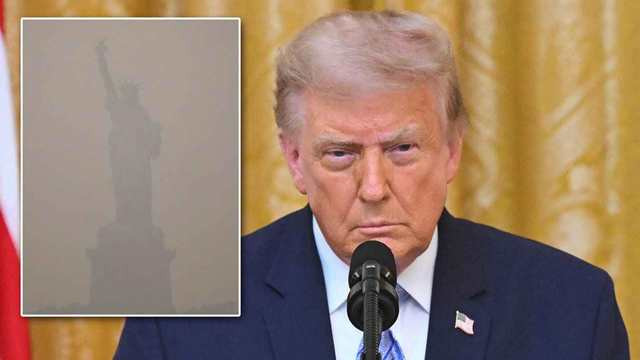
U.S. President Donald Trump has threatened to impose new tariffs on Canada, accusing the country of "deliberate negligence" in forest management as smoke from massive Canadian wildfires continues to blanket large parts of the northern United States.
In a post on Truth Social on Thursday, Trump said the United States was being subjected to an "unnecessary invasion of dirty, polluted, and unhealthy air." He claimed Canada had failed to properly manage its forests and brush, adding that he intended to speak with Canadian Prime Minister Mark Carney to seek an explanation.
Trump also suggested that Canada could face additional tariffs if it is held responsible for the ongoing air pollution affecting the United States.
Nearly 900 Active Wildfires Across Canada
According to the Canadian Wildland Fire Information System, 888 wildfires were active across Canada as of Friday, with most of them still burning out of control.
Ontario alone has recorded more than 190 active wildfires, many of which remain uncontained.
So far this wildfire season, nearly three million hectares of forest have been destroyed, making it one of Canada's most severe fire seasons in recent years.
Smoke Spreads Across Northern United States
Smoke from the Canadian wildfires has drifted across the border, affecting several U.S. states, including Minnesota, Michigan, Wisconsin, Ohio, Pennsylvania, and New York.
Authorities have issued hazardous air quality alerts across many regions, prompting the cancellation of numerous outdoor events, summer camps, concerts, and sporting activities due to health concerns.
According to Swiss air quality monitoring company IQAir, Detroit recorded the world's worst air quality on Friday, followed by Chicago, Washington, D.C., and New York City.
The dense smoke also obscured major landmarks, including New York City's Empire State Building and the Statue of Liberty, while national monuments in Washington, D.C., were shrouded in haze.
Officials have advised residents to remain indoors where possible, and some communities have begun distributing free face masks to protect against the unhealthy air.
U.S. Lawmakers Express Frustration
Republican members of Congress from Michigan—John James, John Moolenaar, Jack Bergman, and Lisa McClain—sent an open letter to Canadian officials, saying their "patience has run out."
The lawmakers argued that despite Canada's promises to improve wildfire prevention after last year's fires, meaningful action had not been taken.
"We are no longer satisfied with expressions of regret," the letter stated. "For years, Americans' lungs have paid the price for Canada's inaction."
The lawmakers criticized Canada for failing to clear forests, reduce combustible vegetation, conduct controlled burns, and crack down on arson. They also warned that the United States may consider direct intervention in managing cross-border wildfires if necessary.
Canada Rejects the Criticism
Responding to Trump's remarks, Canada's Minister of Emergency Management said the two countries have long cooperated in fighting wildfires.
He noted that bilateral coordination continues under the 1982 Reciprocal Forest Fire Fighting Arrangement and agreements reached during the 2025 G7 Summit.
The minister added that Canada has invested approximately C$12 billion in forest conservation and wildfire prevention.
"This is a crisis that recognizes no borders," he said. "Canada is responding quickly, collaboratively, and in close coordination with its partners to protect people's safety."
"Send Help, Not Blame"
Ontario Premier Doug Ford dismissed the criticism from U.S. lawmakers, pointing out that Canada has repeatedly assisted the United States during natural disasters, including California's wildfires and Hurricane response efforts in North Carolina.
"Instead of pointing fingers, send help," Ford said. "That's exactly what Canada has done for our American friends."
Ford added that Democratic-led states such as Michigan and Massachusetts have already offered water-bombing aircraft, firefighters, and emergency personnel to support the firefighting effort.
Since 2018, Ontario has invested more than C$1 billion in wildfire management, with over 150 firefighting teams and more than 80 water bombers and helicopters currently deployed.
Scientists Cite Climate Change as the Primary Driver
Experts argue that blaming Canada alone for the crisis oversimplifies the issue.
Dr. Patrick James, a researcher at the University of Toronto, said wildfire smoke does not respect international borders.
"Weather systems don't recognize national boundaries. Smoke travels wherever the wind carries it," he said, noting that smoke from major U.S. wildfires has also reached Canada in previous years.
Dr. Annabella Bonada of the University of Waterloo said climate change is the underlying cause of increasingly severe wildfire seasons.
"Climate change is a global challenge. It is inaccurate to suggest that Canada alone is responsible for these wildfires or could have prevented them entirely," she said.
FIFA World Cup Final Under Watch
The widespread smoke has also raised concerns over Sunday's FIFA World Cup final at MetLife Stadium in New Jersey, where Argentina is scheduled to face Spain. President Trump is also expected to attend the match.
White House and FIFA officials are closely monitoring air quality and weather conditions. However, meteorologists predict that rainfall over the weekend could help reduce smoke concentrations before kickoff.
Advertisement