১১ আশ্বিন ১৪৩৩



Yunus Calls for Swift Talks on Free Trade Agreement With European Union
02 February 2026 05:02 AM
NEWS DESK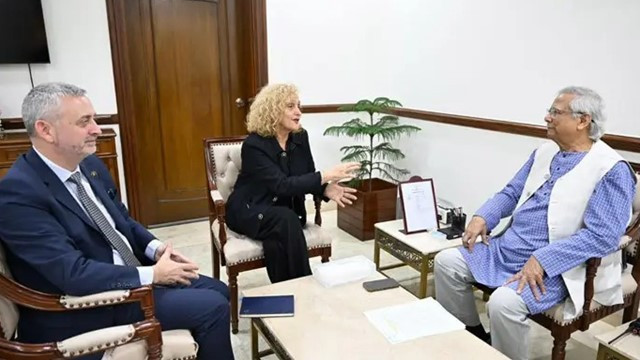
Bangladesh’s Chief Adviser of the interim government, Professor Dr. Muhammad Yunus, has called for the early launch of negotiations on a Free Trade Agreement (FTA) with the European Union to ensure continued access for Bangladeshi exports—particularly readymade garments—after the expiry of the country’s current duty-free trade benefits.
“Preparations must begin now so that Bangladesh’s exports, especially garments, can continue to enjoy uninterrupted access to the EU market even after existing duty-free facilities expire,” Yunus said on Sunday.
He made the remarks during a courtesy meeting with Nuria Lopez, Chairperson of the European Chamber of Commerce in Bangladesh (EuroCham), at the state guest house Jamuna in Dhaka. European Union Ambassador to Bangladesh Michael Miller was also present at the meeting.
The discussion focused on increasing European investment in Bangladesh, smoothing Bangladesh–EU trade relations, and undertaking necessary reforms to strengthen a business-friendly environment. The participants also exchanged views on the upcoming national election and referendum, including the role of international observers.
Yunus noted that Bangladesh recently concluded an Economic Partnership Agreement (EPA) with Japan, under which more than 7,300 Bangladeshi products will receive duty-free access to the world’s fourth-largest economy. He said the government wants to leverage this experience to pursue similar agreements with the European Union and other partners.
“The EPA with Japan has opened new doors of opportunity for us and created fresh momentum for exports. An FTA with the European Union would further expand our market access,” Yunus said.
EuroCham Chairperson Nuria Lopez warned that Bangladesh could lose its existing trade privileges in the EU market after graduating from the Least Developed Country (LDC) category, making early FTA negotiations essential. She said such an agreement would boost European investment, generate employment, and strengthen Bangladesh’s export presence in advanced Western markets.
Lopez noted that India is already moving toward an FTA with the EU, while Vietnam has long benefited from such an agreement, enabling them to remain competitive in the European market as middle-income countries.
“We are actively working in favor of an FTA. We will go to Europe and encourage private companies to invest in Bangladesh,” she said.
EU Ambassador Michael Miller said Bangladesh–EU trade relations will change following Bangladesh’s graduation from LDC status, though not before 2029. He added that the EU is keen to bring investment and technology to Bangladesh, viewing the country as a market of nearly 200 million people. Preparations are underway to host an EU–Bangladesh Business Forum in 2026, he said.
“It is important to send early political signals so that EU companies feel confident and have equal opportunities to invest in Bangladesh,” Miller said.
Yunus said European companies could also find significant opportunities in relocating factories to Bangladesh, citing the country’s skilled workforce and comparatively low production costs as major advantages. He added that the government is developing a free trade zone aimed at transforming Bangladesh into a global manufacturing hub.
Calling the EU’s decision to deploy a large observer mission for the upcoming national election and referendum a positive step, Yunus said the presence of EU observers would be “a strong symbol of confidence” in Bangladesh’s efforts to revive democracy.
“The overall environment for election campaigning has so far been positive,” he added.
The meeting was also attended by Lamia Morshed, Senior Secretary and SDG Coordinator of the Bangladesh government.