২৯ আশ্বিন ১৪৩৩



Hasina’s Legal Team Urges UN Rights Chief to Retract Bangladesh Protest Death Toll Claim
02 June 2026 00:06 AM
NEWS DESK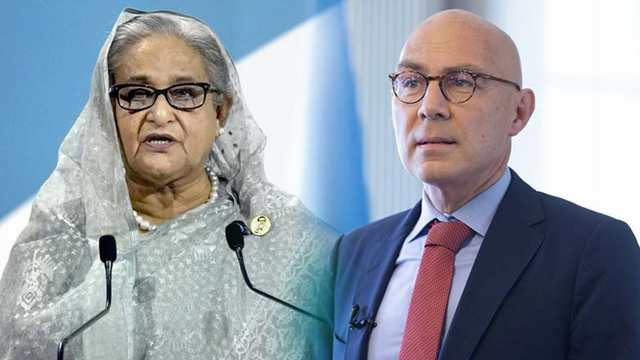
A legal advisory firm representing former Bangladeshi Prime Minister Sheikh Hasina has written to United Nations High Commissioner for Human Rights Volker Türk, expressing serious concerns over a UN fact-finding report on alleged human rights violations during Bangladesh’s July–August 2024 uprising.
The letter, sent on Thursday by London-based law firm Doughty Street Chambers, challenges the findings of the report titled “Human Rights Violations and Abuses Related to the Protests of July and August 2024 in Bangladesh,” published by the Office of the High Commissioner for Human Rights (OHCHR) on February 12, 2025.
In the letter, the firm states that newly available information, including documents issued by Bangladesh’s interim government, indicates that the report’s conclusion that up to 1,400 protesters were killed during the unrest was “seriously flawed” and inconsistent with verified facts.
According to the letter, an official government gazette has since confirmed a death toll of approximately 834, nearly half the figure cited in the UN report. The firm also noted that some independent reports place the number even lower and argued that the discrepancy raises significant concerns about the credibility of the fact-finding process.
The lawyers urged the OHCHR to issue a correction and publicly withdraw the section of the report that refers to the estimated death toll of 1,400 protesters.
Representing Sheikh Hasina, the firm argued that the situation may have resulted from a failure by UN investigators to adequately verify politically motivated allegations against the former prime minister. The letter notes that the OHCHR investigation was conducted at the invitation of Bangladesh’s interim government and focused on alleged abuses committed between July 1 and August 15, 2024.
The letter further claims that the interim administration led by Nobel laureate Dr. Muhammad Yunus has itself faced allegations of widespread human rights abuses since taking office on August 8, 2024. It states that such allegations have been documented by several non-governmental organizations and have also been included in communications submitted to the Office of the Prosecutor of the International Criminal Court (ICC).
Doughty Street Chambers also questioned the independence of the UN investigation, citing comments attributed to Dr. Yunus regarding the planning and organization of the movement that led to Sheikh Hasina’s removal from power. The firm argued that the apparent involvement of Hasina’s political opponents in the information-gathering process raises concerns about the neutrality and impartiality of the report.
Another major criticism raised in the letter concerns the limited scope of the UN inquiry. The lawyers argued that because the investigation only covered events between July 1 and August 15, 2024, it did not examine alleged human rights violations committed by the interim government after it assumed power. These, the letter claims, include violence against Awami League representatives and attacks on religious minorities.
Questioning the reported casualty figures, the firm pointed to the UN report’s assessment that as many as 1,400 people may have been killed during the protests, with most deaths allegedly caused by military rifles and shotgun ammunition commonly used by Bangladeshi security forces.
The letter notes that OHCHR arrived at its estimate by comparing Health Ministry data with detailed casualty lists collected from civil society organizations and other sources while removing duplicate entries. However, the firm argues that the revised official figure of 834 deaths significantly undermines the UN’s conclusion.
It further states that even the 834 figure may not be entirely reliable due to possible political considerations. The lawyers cited figures from the student-led Anti-Discrimination Movement, which reportedly estimated the death toll at around 650.
According to the letter, a truly independent and impartial investigation could potentially produce an even lower casualty figure.
The firm acknowledged that the deaths represented a serious human tragedy and noted that Sheikh Hasina’s government had been in the process of establishing a commission to investigate allegations of excessive force by police and security personnel. However, it argued that inflated casualty figures were used to exaggerate the scale of violence and portray Hasina as having ordered the mass killing of peaceful demonstrators.
The letter contends that the UN report was subsequently used to support what it described as false and inflammatory narratives that helped legitimize efforts to remove the government from power.
Calling the situation “deeply unfortunate,” the lawyers warned that it could set a troubling precedent for the misuse of UN human rights mechanisms in future political conflicts.
The letter concludes by urging the OHCHR to publicly correct and withdraw the section of the report referring to the alleged death toll of 1,400 protesters. Such action, it says, is necessary to prevent the United Nations from inadvertently sustaining what it describes as a false narrative about the events that unfolded in Bangladesh during July and August 2024.