১৯ আশ্বিন ১৪৩৩



EU Sees Bangladesh as a Strategic Partner Beyond Traditional Aid Relationship
04 October 2026 18:10 PM
NEWS DESK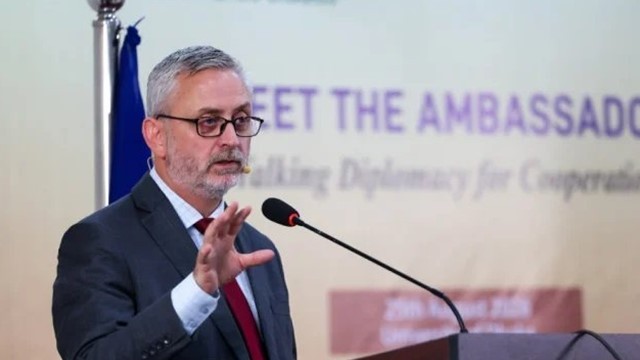
European Union Ambassador to Bangladesh Michael Miller has said the EU now views Bangladesh not merely through the traditional donor-recipient framework, but as a strategic partner of growing geopolitical significance, particularly in the Bay of Bengal and the wider Indo-Pacific region.
Speaking on Sunday during the second day's working session of the Bay of Bengal Conversation 2026, organized by the Centre for Governance Studies (CGS) at a hotel in Dhaka, Miller highlighted Bangladesh's increasing importance in regional and global affairs.
"Bangladesh holds immense strategic significance in South Asia, the Bay of Bengal, and the broader Indo-Pacific region," he said. "It is now one of the world's most dynamic economies and has the potential to become one of the world's top 30 economies by 2030."
Miller noted that Bangladesh is currently at a critical stage in its development journey, facing multiple challenges simultaneously. These include its graduation from Least Developed Country (LDC) status, ongoing political transition, rebuilding accountable state institutions, economic pressures, and the growing global risks posed by climate change.
The EU ambassador said that while the European Union has long supported Bangladesh's development through its Everything But Arms (EBA) preferential trade scheme, the relationship is now evolving beyond that framework.
"The EU wants to build a more ambitious partnership with Bangladesh," he said, adding that alongside supporting a smooth transition from LDC status, the bloc is also exploring the possibility of negotiating a bilateral Free Trade Agreement (FTA) with Bangladesh.
Miller noted that this marks the first time the European Union has considered offering such a trade arrangement to a country that has not yet fully completed its LDC graduation process.
He also emphasized the importance of creating a fair and predictable business environment for European companies operating in Bangladesh. According to the ambassador, stronger institutions and independent oversight mechanisms are essential to help the country navigate geopolitical and technological changes while sustaining investor confidence.
Referring to the political developments following the 2024 mass uprising, Miller said the constitutional reform process remains incomplete. He stressed that broad national consensus among political parties would be necessary to successfully carry forward the reform agenda and strengthen democratic governance.