[email protected]
শনিবার, ২৬ সেপ্টেম্বর ২০২৬
১১ আশ্বিন ১৪৩৩
১১ আশ্বিন ১৪৩৩

Saturday, 26th September 2026


Trump Orders Major Overhaul of Childhood Vaccine Recommendations, Calls for Fewer Shots
12 August 2026 12:08 PM
NEWS DESK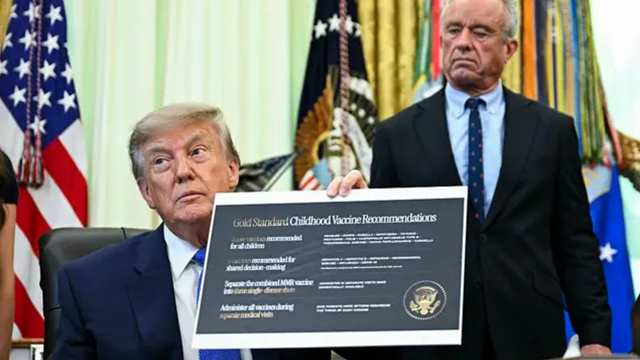
US President Donald Trump has signed an executive order directing a major overhaul of federal childhood vaccine recommendations, including reducing the number of vaccines recommended for all children and separating the measles, mumps and rubella (MMR) vaccine into three individual shots.
Trump signed the order on Monday, August 10, saying the changes would reduce the number of vaccines routinely recommended for American children. Under the new framework, federal health officials are expected to recommend vaccines against 11 diseases for all children, down from 18 diseases covered by previous federal recommendations.
Speaking at the White House, Trump argued that children received far fewer vaccines decades ago and claimed that people were healthier at the time and that autism was not as common. However, decades of scientific research have found no causal link between childhood vaccines, including the MMR vaccine, and autism.
The order also calls for the combined MMR vaccine to be separated into individual measles, mumps and rubella vaccinations, potentially requiring separate medical visits. Public-health experts have questioned the scientific basis for the change, noting that there is no established evidence that splitting the combined vaccine provides a health benefit.
The 11 diseases included in the new federal recommendations are measles, mumps, rubella, diphtheria, tetanus, pertussis, polio, Haemophilus influenzae type B, pneumococcal disease, human papillomavirus (HPV) and varicella, or chickenpox.
Trump said the administration was reducing the number of recommended vaccinations and described the move as reducing the number of “needles” children receive.
He also suggested that administering the MMR vaccine as a combined shot could be dangerous, comparing it to putting a large amount of soda into a child’s body. When asked by a reporter for evidence supporting his claim that the combined vaccine could be “lethal,” Trump said that he had heard some people make such a claim.
Medical evidence does not support that assertion. The Centers for Disease Control and Prevention (CDC) says most people who receive the MMR vaccine do not experience serious problems, and vaccination is substantially safer than contracting measles, mumps or rubella. The CDC recommends two routine MMR doses for children—typically the first at 12–15 months and the second at 4–6 years of age.
The CDC notes that young children face a very small risk of febrile seizures after MMR vaccination. Children with certain medical conditions, including severe allergic reactions or compromised immune systems, may need special medical advice before vaccination.
Experts have warned that separating vaccines or extending the intervals between doses could leave children vulnerable to preventable diseases for longer periods. Requiring additional appointments may also increase the likelihood that families delay or miss vaccinations. The World Health Organization has defended evidence-based immunization schedules and said vaccination recommendations are based on decades of research and country-specific disease risks.
Trump’s Health and Human Services Secretary Robert F. Kennedy Jr. has said the proposed changes are intended to give parents greater choice rather than eliminate access to vaccines. Kennedy has sought changes to federal vaccine policy since taking office in 2025.
Administration officials have claimed that children will receive substantially fewer vaccine doses under the new recommendations than under the previous schedule. Vaccine experts, however, have disputed some of the administration’s comparisons, saying they can be misleading because combination vaccines are sometimes counted as multiple individual injections and annual influenza and COVID-19 vaccines may also be included in the calculation.
The executive order does not directly determine school vaccination requirements. Those requirements are largely established by individual states rather than the federal government. As a result, the order does not automatically change the vaccines children must receive to attend school.
The American Academy of Pediatrics has strongly criticized the move. AAP President Dr. Andrew Racine called the order dangerous and noted that it comes amid a significant resurgence of measles in the United States. Public-health experts have warned that delaying or skipping childhood vaccinations could increase the risk of outbreaks of measles and other preventable diseases.
Republican Senator Bill Cassidy, a physician, also criticized the order, saying vaccines are safe and effective and that scientific evidence does not support a link between vaccines and autism. He urged parents to rely on advice from their children’s pediatricians rather than what he described as misinformation in the executive order.
Multiple studies have found no association between MMR vaccination and autism. A large Danish study published in 2019, involving 657,461 children, found no evidence supporting the claim that MMR vaccination causes autism.
The executive order also calls for research into alternatives to aluminum-containing vaccine adjuvants and an assessment of whether such alternatives would be safer or more effective. The American Academy of Pediatrics has rejected claims that the small amounts of aluminum salts used in some vaccines cause autism or other serious developmental or neurological problems.
Aluminum salts have been used as vaccine adjuvants for decades to strengthen the body’s immune response. According to pediatric health experts, their use can help vaccines produce effective immunity with smaller amounts of vaccine and fewer doses.
The new policy has triggered a broader debate over the role of federal health authorities, parental choice and scientific evidence in determining childhood vaccination schedules. Public-health experts warn that any reduction in vaccination coverage could increase children’s vulnerability to diseases that have previously been controlled through widespread immunization.
Advertisement