
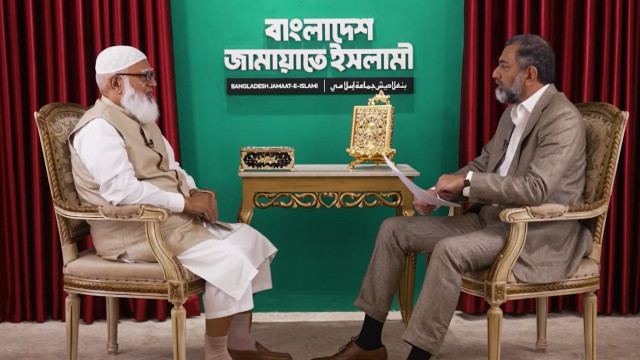
The interview, conducted by Al Jazeera journalist Srinivasan Jain, covered a wide range of issues, including the upcoming 13th national parliamentary election, implementation of Islamic law, women’s rights, minority security, Jamaat’s role in 1971, media freedom, and Bangladesh–India relations.
Women’s Leadership and Elections
Responding to a question on female leadership, Dr. Shafiqur Rahman said Jamaat-e-Islami will not field any female candidates in the upcoming parliamentary elections. However, he noted that the party is preparing women for the future and that women have already participated successfully in local government elections. He added that the possibility of women contesting parliamentary seats may be considered in the future.
At the same time, he firmly rejected the idea of a woman serving as the party’s Ameer. He argued that men and women have fundamental differences ordained by God, and that responsibilities such as childbirth and child-rearing make it impossible for women to shoulder the organization’s highest responsibility. When the interviewer cited Bangladesh’s long history of female political leadership, he responded that most countries around the world have traditionally not accepted women as leaders, calling it a “reality.”
Islamic Law and Governance
On the question of implementing Islamic law, Dr. Rahman said Jamaat is participating in elections under the existing constitution and will not impose any decision against the will of the people. He stressed that parliament—not any individual—would decide what is necessary for the country’s development. He claimed that Jamaat’s core objectives are fighting corruption, ensuring transparency, and protecting democratic and human rights.
Women’s Working Hours and Maternity Leave
Addressing controversy over his comments on reducing women’s working hours, he said his remarks had been misrepresented. He argued that women deserve special consideration during pregnancy and child-rearing, and that six months of maternity leave is insufficient. However, when Al Jazeera pointed to concerns and protests from working women, he dismissed those protests as “insignificant,” claiming women actually feel relieved by such measures.
Media and Cultural Institutions
Regarding recent anti-media and anti-cultural statements made by Jamaat-backed student leaders, Dr. Rahman said these do not reflect the party’s official stance. He stated that Jamaat has condemned those remarks and that the issue falls under the internal affairs of Islami Chhatra Shibir.
Minorities and the Role in 1971
Denying allegations of attacks on minorities, he said Jamaat was not involved in such incidents and challenged human rights organizations to provide specific evidence. On war crimes related to 1971, he claimed Jamaat was not involved in atrocities and described the trials as politically influenced and controversial. He acknowledged, however, that as a human organization, mistakes could have been made and said the party had previously offered an unconditional apology.
Bangladesh–India Relations
On relations with India, Dr. Rahman said that if Jamaat comes to power, ties with New Delhi would be based on brotherhood and mutual respect. He added that India’s refusal to send Sheikh Hasina back to Bangladesh would be resolved through dialogue.
Expectations of the Youth
In the final part of the interview, he said recent victories by Islami Chhatra Shibir in university student union elections show that young people are placing trust in Jamaat’s ideology. Ultimately, he said, it is the people who will decide whether Jamaat can bring meaningful change.