১৮ আশ্বিন ১৪৩৩



Jamaat-e-Islami Set to Become Fourth Largest Opposition Party in Bangladesh Parliament
19 February 2026 06:02 AM
NEWS DESK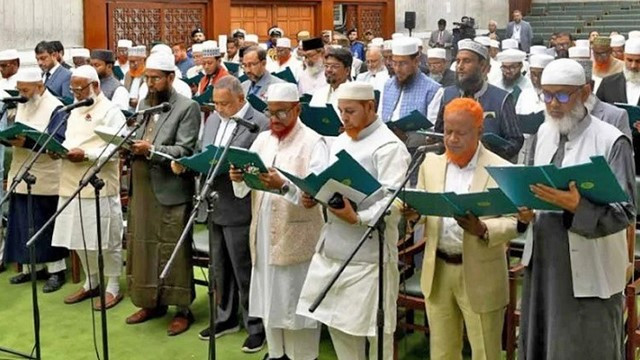
With 68 seats won independently, Jamaat-e-Islami is set to become the fourth largest party in the history of Bangladesh’s Parliament.
On Tuesday, the party held a parliamentary meeting and elected Shafiqur Rahman as the Leader of the Opposition, with Naib-e Amir Syed Abdullah Md. Taher serving as Deputy Leader.
Jamaat’s electoral alliance partner, the National Committee Party (NCP), may have Nahid Islam as the Chief Whip of the opposition. While the 11-party coalition met together on Tuesday, the NCP is reportedly considering forming a separate parliamentary group. However, this is not yet finalized. The recognition of the opposition in Parliament will also be confirmed by the Speaker once the session begins.
In total, Jamaat’s alliance won 77 seats: Jamaat-e-Islami 68, NCP 6, Bangladesh Khelafat Majlis 2, and Khelafat Majlis 1.
Historically, the largest single opposition party was Bangladesh Nationalist Party (BNP), which won 116 seats in the Seventh Parliament of June 1996. Previously, in 1991, the Fifth Parliament saw the opposition Awami League with 88 seats. In 1986, the Awami League held 76 opposition seats. By comparison, Jamaat’s 68 seats will make it the fourth largest single-party opposition in the country’s parliamentary history.
The first Parliament of 1973 had seven opposition MPs. In 1979, the second Parliament saw Awami League with 39 seats and Asaduzzaman as opposition leader. Sheikh Hasina served as opposition leader in the third Parliament (1986). The fourth Parliament of 1988, formed without BNP or Awami League, had ASM Abdur Rahman as opposition leader with 19 combined opposition seats.
Under the caretaker government system, the 1991 February elections saw BNP win 140 seats and Awami League 84 seats, with Sheikh Hasina as opposition leader. In the short-lived Sixth Parliament of February 1996, the opposition leader post was vacant, while the Seventh Parliament of June 1996 saw Khaleda Zia as opposition leader.
In the Eighth Parliament (2001), Sheikh Hasina led the opposition with 62 seats. The Ninth Parliament (2008) had BNP with 30 seats. The Tenth Parliament (2014) saw the opposition led by Jatiya Party’s Rowshan Ershad with 34 seats. In the Eleventh Parliament (2018), Hussein Muhammad Ershad was opposition leader with 22 seats; after his death, Rowshan Ershad resumed the role. In the Twelfth Parliament (2024), the opposition was led by Jatiya Party’s GM Quader with 11 seats until the Parliament was dissolved following the July popular uprising.
In Bangladesh’s Parliament, the opposition leader holds ministerial rank equivalent to a full cabinet minister, while the deputy enjoys the status of a state minister. The opposition chief whip, however, does not have ministerial privileges like the government’s chief whip.