৬ আশ্বিন ১৪৩৩



Bangladesh PM Tarique Rahman Urges Malaysia to Reopen Labor Market for Bangladeshi Workers
23 June 2026 03:06 AM
NEWS DESK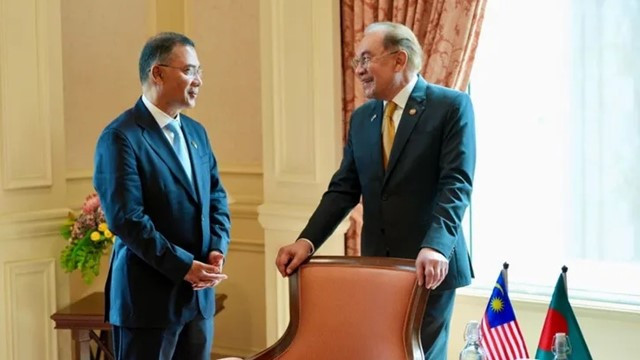
Bangladesh Prime Minister Tarique Rahman has urged Malaysian Prime Minister Anwar Ibrahim to expedite the reopening of Malaysia’s labor market for Bangladeshi workers and increase recruitment from Bangladesh.
Speaking at a joint press conference at the Malaysian Prime Minister’s Office in Putrajaya on Monday, Rahman said he had raised several labor-related issues during bilateral talks with his Malaysian counterpart.
“I requested Prime Minister Anwar Ibrahim to consider recruiting more Bangladeshi workers and reopening the labor market as soon as possible. I also raised the issues of regularizing undocumented workers and the possible repatriation of detained Bangladeshi nationals,” Rahman said.
He added that both leaders agreed that worker recruitment procedures should be transparent, fair, and affordable, reducing the role of intermediaries and lowering costs for migrant workers.
The joint press conference followed a high-level bilateral meeting between the two leaders. Prime Minister Anwar Ibrahim delivered opening remarks before Rahman briefed the media on the outcomes of their discussions.
At the beginning of his speech, Rahman thanked Anwar Ibrahim for his warm hospitality. He recalled that the Malaysian prime minister was among the first foreign leaders to congratulate him after he assumed office in February and extended an invitation to visit Malaysia.
Rahman said he felt honored to accept the invitation and was delighted to make Malaysia his first foreign destination as prime minister, accompanied by his wife.
The Bangladeshi leader also recalled the 1979 visit of his father, former President Ziaur Rahman, to Malaysia, saying it helped strengthen political ties between the two countries and laid the foundation for labor cooperation. He also remembered former Prime Minister Begum Khaleda Zia’s visit to Malaysia in 1993, which he said further deepened bilateral friendship and opened new avenues for cooperation.
Describing Malaysia as a long-standing and trusted partner of Bangladesh, Rahman said the relationship between the two nations is built on mutual trust, shared values, and strong people-to-people connections.
The two leaders discussed a broad range of bilateral, regional, and international issues. Rahman said they reaffirmed their commitment to strengthening Bangladesh–Malaysia relations and agreed to enhance engagement through existing mechanisms, including Joint Commission meetings and bilateral consultations between the foreign ministries of both countries.
The prime minister welcomed the growth in bilateral trade and announced that both sides had agreed to advance discussions on a Bangladesh–Malaysia Free Trade Agreement (FTA).
He also welcomed the signing and exchange of several agreements and documents following the meeting, including a memorandum of understanding on cultural cooperation, a document on research and capacity-building in counterterrorism, and an investment-related bilateral agreement.
“These initiatives will further strengthen our cooperation and help maintain the positive momentum in our relationship,” Rahman said.
Expressing confidence in the future of bilateral ties, he said the day’s discussions marked the beginning of a new chapter in Bangladesh–Malaysia relations and would contribute to shared prosperity, regional peace, and a more inclusive international order.
Rahman also invited Malaysian businesses to invest in Bangladesh, highlighting the country’s efforts to restore political stability and create an investment-friendly environment.
“The Bangladesh Nationalist Party (BNP) received strong public support in the February 12, 2026 parliamentary elections. Based on this mandate, we have restored political stability through democratic processes. Our priorities are job creation, attracting foreign investment, and accelerating economic growth,” he said.
He identified several sectors with strong potential for Malaysian investment, including information and communication technology (ICT), energy, infrastructure, manpower, halal industries, agro-processing, education, skills development, defense, the digital economy, semiconductors, and other high-value-added industries.
Rahman noted that Bangladeshi workers, students, professionals, and entrepreneurs living in Malaysia serve as an important bridge between the two countries and make significant contributions to both societies and economies.
On the Rohingya crisis, he expressed deep concern over the plight of the displaced population sheltered in Bangladesh and thanked Malaysia for its continued support for their safe, dignified, and sustainable repatriation.
The prime minister also emphasized Bangladesh’s desire for closer engagement with ASEAN and reiterated the country’s aspiration to become an ASEAN Sectoral Dialogue Partner. He further stated that Bangladesh is interested in joining the Regional Comprehensive Economic Partnership (RCEP) and thanked Malaysia for supporting the country’s regional integration efforts.
The two leaders also exchanged views on global issues, including developments in the Middle East, and reaffirmed their commitment to working together at the United Nations and other international forums. Rahman thanked Malaysia for supporting Bangladesh’s candidacy for the presidency of the 81st session of the UN General Assembly.
Concluding his remarks, Rahman invited Prime Minister Anwar Ibrahim and his spouse to visit Bangladesh at a mutually convenient time.
“The people of Bangladesh would be honored to welcome them,” he said.
The Bangladeshi delegation was led by Prime Minister Tarique Rahman, while the Malaysian delegation was headed by Prime Minister Anwar Ibrahim. The talks focused on strengthening bilateral relations and expanding cooperation across a wide range of sectors.