১৪ আশ্বিন ১৪৩৩



Parliament Passes Tk 9.38 Trillion Budget for FY2026-27
01 July 2026 04:07 AM
NEWS DESK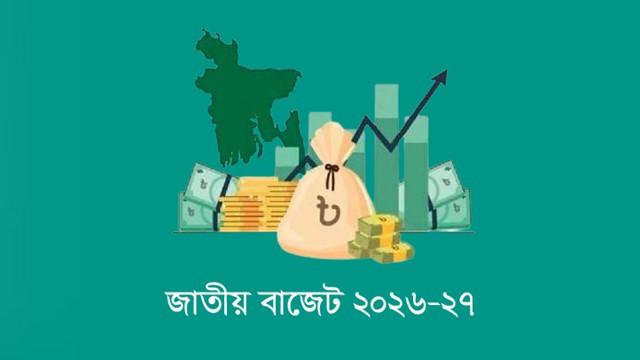
Bangladesh's Parliament on Tuesday passed a Tk 9.38 trillion (Tk 938,000 crore) national budget for the 2026-27 fiscal year, which will take effect on Wednesday, July 1. The first budget of the BNP-led government outlines a comprehensive roadmap aimed at building a more inclusive and people-centered economy.
The budget was approved by voice vote during a parliamentary session presided over by Speaker Hafiz Uddin Ahmed.
The government has set an ambitious target of achieving 6.5 percent economic growth while reducing inflation to 7.5 percent during the next fiscal year.
The budget marks the first financial plan of the BNP government following its landslide victory in the February 12 general election. The last national budget presented by a BNP-led administration was for the 2006-07 fiscal year, introduced by then Finance Minister M. Saifur Rahman.
The new budget projects a Tk 243,000 crore deficit, equivalent to 3.6 percent of gross domestic product (GDP). The overall budget size represents approximately 13.7 percent of the country's projected GDP.
To accelerate economic recovery, Finance Minister Amir Khasru Mahmud Chowdhury unveiled a "3R Strategy" aimed at revitalizing the economy and steering Bangladesh toward becoming a US$1 trillion economy.
The three phases of the strategy include Recovery and Stabilization, Restoration, and Reconstruction for Acceleration, with implementation planned over the next one to five years.
The government has set a Tk 695,000 crore revenue collection target, including Tk 604,000 crore to be collected through the National Board of Revenue (NBR).
To facilitate budget implementation, the finance minister also placed the Appropriation Bill, 2026 before Parliament, seeking authorization for Tk 1.515 quadrillion (Tk 15,15,439 crore) in government expenditure. The bill was subsequently passed by voice vote.
On Monday, Parliament also approved the Finance Bill, 2026, incorporating several key amendments, including an increase in the tax-free income threshold and the removal of the mandatory disclosure requirement for investment information.
Before the passage of the Appropriation Bill, ministers defended expenditure proposals for their respective ministries under 59 separate demands for grants, covering both development and non-development spending.
Opposition lawmakers submitted 1,343 cut motions against the 59 demands for grants, but Parliament rejected all of them by voice vote.
A total of 43 Members of Parliament, including representatives from Bangladesh Jamaat-e-Islami, the National Citizen Party (NCP), and independent lawmakers, participated in discussions on cut motions covering 36 ministries and divisions.
The ministries and agencies discussed included the Prime Minister's Office, Cabinet Division, Ministry of Public Administration, Bangladesh Public Service Commission Secretariat, Finance Division, Office of the Comptroller and Auditor General, Internal Resources Division, Financial Institutions Division, Economic Relations Division, Planning Division, Implementation Monitoring and Evaluation Division (IMED), Ministry of Commerce, Ministry of Foreign Affairs, Law and Justice Division, Ministry of Home Affairs, Ministry of Primary and Mass Education, Secondary and Higher Education Division, Ministry of Science and Technology, Health Services Division, Information and Communication Technology Division, Ministry of Social Welfare, Ministry of Women and Children Affairs, Ministry of Labour and Employment, Ministry of Housing and Public Works, Ministry of Information and Broadcasting, Ministry of Youth and Sports, Ministry of Industries, Ministry of Agriculture, Ministry of Environment, Forest and Climate Change, Ministry of Land, Ministry of Water Resources, Road Transport and Highways Division, Ministry of Railways, Ministry of Civil Aviation and Tourism, Posts and Telecommunications Division, and the Anti-Corruption Commission.
At the request of Leader of the Opposition Dr. Shafiqur Rahman, the Speaker applied the guillotine procedure, allowing the remaining demands for grants to be approved together by voice vote without detailed discussion.
Opposition and independent lawmakers were present during the passage of the Appropriation Bill and did not raise any objections to its approval.