The incident marks a significant escalation in the ongoing conflict and raises new concerns about Iran’s missile capabilities and broader geopolitical intentions.
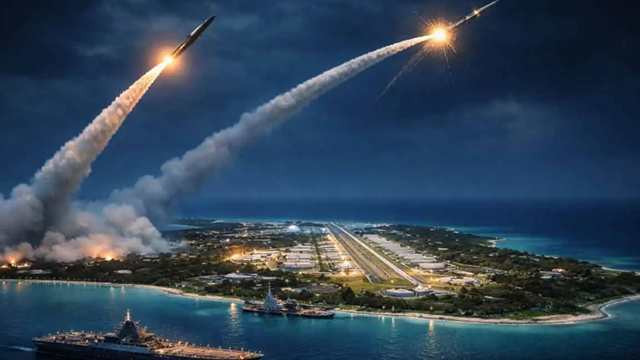
According to multiple media reports, one of the missiles broke apart mid-flight, while the other was intercepted before reaching its target. Despite the failed strike, analysts say the attempt itself has altered the strategic risk landscape.
Diego Garcia, a remote coral island under British control, lies roughly 4,000 kilometers from Iran. Until now, Tehran has consistently claimed that its ballistic missiles have a maximum range of about 2,000 kilometers. If Iran indeed attempted to strike a target at twice that distance, it suggests the existence of previously undisclosed capabilities.
Experts believe Iran may have tested a system approaching the range of an intermediate-range ballistic missile (IRBM), potentially capable of reaching deep into the Indian Ocean and even parts of southern Europe. By maintaining ambiguity about its true capabilities, Tehran may be gaining a strategic advantage over its adversaries.
This uncertainty complicates military planning for both the United States and the United Kingdom. It is also likely to prompt Gulf nations and Israel to reassess their missile defense systems.
Diego Garcia is a critical hub for U.S. global power projection, serving as a key logistics and strike platform. It hosts advanced bombers and surveillance aircraft essential for operations across multiple regions.
Iran’s semi-official Mehr News Agency described the targeting of the base as a significant step, asserting that it demonstrates a missile reach beyond what adversaries had previously assumed.
By attempting to strike Diego Garcia, Iran appears to be expanding the geographical scope of the conflict beyond the Middle East into the Indian Ocean region. The move sends a clear message: no U.S. base is beyond its reach. This could force Washington and London to reposition missile defense assets further south, adding complexity to their military posture.
Analysts emphasize that the political implications of demonstrating reach may outweigh the technical outcome of the strike. Reports indicate that the United States may have used an “SM-3” interceptor missile, though the effectiveness of the interception remains unclear.
Even if the interception was successful, some analysts argue Iran may still claim a political victory—either by forcing the use of advanced U.S. defense systems or by exposing potential vulnerabilities in missile defense.
A report by Al Jazeera highlighted that the attempted strike underscores Iran’s long-range strike ambitions. Brussels-based military and political analyst Elijah Magnier stated that the attack reflects the depth of Iran’s response to the war initiated on February 28 by the United States and Israel.
“The battlefield is expanding geographically,” Magnier said. “As that happens, controlling escalation becomes much more difficult, especially for the United States, as new locations and installations come under threat.”
He added that Washington may need to rethink its overall strategy. “Iran is not trying to win a conventional war—it cannot, given the overwhelming strength of the United States. Instead, it is attempting to alter the cost equation of the conflict,” he said.