The U.S. objective is to destroy these attack boats, as well as missile bases along Iran’s coastline and nearby islands, in order to reopen the waterway and ease global energy disruptions. However, analysts warn that the most serious threats in the narrow strait are not always visible from the air.
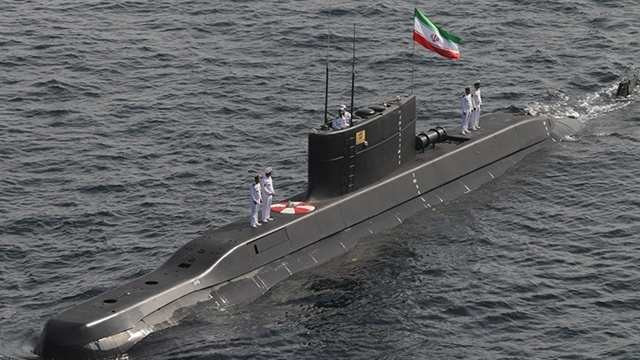
One of the most significant dangers comes from Iran’s fleet of small “midget” submarines, particularly the Ghadir-class submarine. Iran is believed to operate around 10 of these submarines, each weighing about 120 tons and measuring roughly 29 meters in length—far smaller than conventional attack submarines.
By comparison, the Ohio-class submarine weighs around 18,750 tons and is about 170 meters long. The small size of the Ghadir-class allows it to operate effectively in shallow waters, even at depths of around 30 meters, which matches the average depth of key shipping channels in the strait.
The shallow, noisy environment of the Persian Gulf—combined with heavy ship traffic and drilling activity—makes detecting these submarines extremely difficult for U.S. forces. These submarines are capable of launching torpedoes such as the Hoot torpedo, which Iranian sources claim can reach speeds of up to 220 miles per hour underwater using supercavitation technology.
Analysts suggest that a single undetected Ghadir-class submarine could deploy dozens of naval mines in shipping lanes overnight. Iran has spent decades studying the unique conditions of the Gulf and has trained its submarine crews specifically for operations in these waters.
In addition to submarines, Iran’s naval arsenal includes swimmer delivery vehicles such as the Al-Sabehat, which can be used for covert operations and mine placement in shallow coastal areas. These can also be modified into explosive-laden suicide vessels.
Iran also operates larger submarines like the Fateh-class submarine, as well as older models such as the Kilo-class submarine, acquired from Russia in the 1990s. However, these larger submarines are less effective in the shallow northern parts of the Gulf.
The Islamic Revolutionary Guard Corps Navy controls hundreds of fast attack boats designed for swarm tactics in confined waters. Among them, the Zolfaghar-class boat is one of the more capable platforms, equipped with air defense systems.
Iran has also developed unconventional platforms such as the Bavar 2, a ground-effect vehicle that skims just above the water to evade radar detection. In recent years, Iran has showcased remote-controlled explosive boats that can be pre-positioned and activated when needed.
While U.S. airstrikes have destroyed some naval bases, these small boats require minimal launch infrastructure and can be hidden in civilian ports, making them difficult to eliminate.
Iran’s mobile, truck-mounted anti-ship missiles pose an even greater long-term threat. Systems such as the Noor missile and Qadir missile have ranges capable of striking targets well beyond the strait, including deep into the Gulf of Oman.
Additionally, Iran has developed anti-ship ballistic missiles like the Hormuz-2 missile, designed to hit moving vessels using satellite guidance. These systems are mobile, often hidden in tunnels or hardened bunkers, and frequently relocated.
Iran has also demonstrated the ability to launch drones from submarines, including systems like the Hadid-110 drone.
However, analysts emphasize that the most dangerous capability may not be torpedoes or missiles, but naval mines. Iran is believed to possess a large stockpile of mines, including contact, magnetic, acoustic, and pressure-triggered variants. More advanced versions can distinguish between vessel types, allowing them to ignore small minesweepers while targeting large oil tankers.
This layered naval strategy—combining stealth, mobility, and asymmetric tactics—gives Iran significant leverage over one of the world’s most critical maritime chokepoints, raising concerns about global trade and energy security.