১২ আশ্বিন ১৪৩৩



Bangladesh–India Relations Highlighted at Independence Day Reception in New Delhi
28 March 2026 03:03 AM
NEWS DESK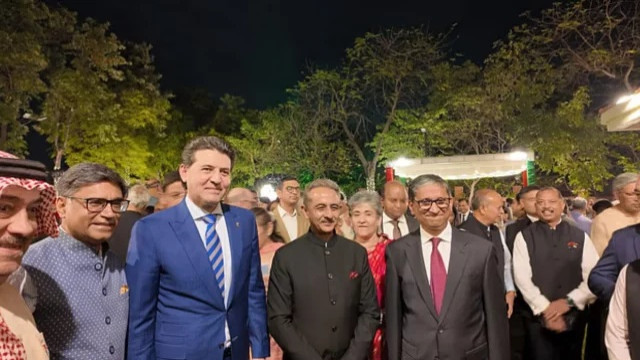
The positive momentum in Bangladesh–India bilateral relations was highlighted on Thursday at a reception held at the Bangladesh High Commission residence in New Delhi, marking the country’s 56th Independence Day.
Speaking at the event, Bangladesh High Commissioner to India Riaz Hamidullah and India’s Minister of State for External Affairs Kirti Vardhan Singh emphasized the depth and diversity of ties between the two countries, stressing mutual goodwill and shared interests.
High Commissioner Hamidullah expressed gratitude for India’s support during Bangladesh’s Liberation War in 1971. In response, Singh said India is eager to work with Bangladesh’s new government to further strengthen cooperation across multiple sectors.
The High Commission premises and the adjoining residence were decorated for the occasion. Guests were welcomed and escorted along a red carpet to a lawn illuminated with decorative lights. The formal program remained brief, beginning with the national anthems of both countries.
In his speech, Hamidullah paid tribute to the sacrifices of Bangladesh’s freedom fighters and the countless people who resisted the Pakistani occupation forces. He also acknowledged the contributions of Indian soldiers and civilians, noting that 1,668 Indian soldiers lost their lives on Bangladeshi soil during the war.
He highlighted the role played by people from West Bengal, Tripura, and India’s northeastern region, who provided both material and moral support to the freedom fighters.
Hamidullah also recalled that the declaration of Bangladesh’s independence was made on behalf of the people by Major Ziaur Rahman.
Emphasizing the deep cultural and human connections between the two nations, he referred to shared traditions in agriculture, textiles, crafts, literature, music, and the arts. He mentioned prominent figures such as Rabindranath Tagore, Kazi Nazrul Islam, Satyajit Ray, Ritwik Ghatak, Prafulla Chandra Ray, Satyendra Nath Bose, Ustad Alauddin Khan, and Pandit Ravi Shankar.
He noted that the historic “Concert for Bangladesh,” organized at Ravi Shankar’s initiative, helped shift global attention from the situation in then-East Pakistan to Bangladesh’s liberation struggle.
Hamidullah described these shared legacies as a reflection of deep cultural integration and long-standing human connections. He added that this tradition reflects inclusivity and allows citizens of Bangladesh to live freely with their beliefs and pursue progress.
He also pointed to recent high-level exchanges as signs of positive engagement, including the presence of India’s External Affairs Minister S. Jaishankar at the funeral of former Prime Minister Begum Khaleda Zia, a visit by Defence Minister Rajnath Singh to the Bangladesh High Commission in Delhi, and participation by Indian officials in the swearing-in ceremony of Prime Minister Tarique Rahman.
Referring to Bangladesh’s “Bangladesh First” policy, Hamidullah said the current leadership is committed to maintaining partnerships with India and other countries based on mutual respect and shared interests.
Amid global uncertainties, he stressed the need for closer cooperation and mentioned a letter sent by Prime Minister Tarique Rahman to Indian Prime Minister Narendra Modi, expressing hope for advancing ties based on equality, trust, and mutual benefit. He said bilateral trade, currently around $12 billion, has the potential to grow to $28–30 billion.
Hamidullah also remembered late Assamese singer Zubeen Garg, recalling a meeting with him in Guwahati last July, where Garg emphasized connections among people through natural and cultural links beyond social divisions.
Echoing similar sentiments, Kirti Vardhan Singh said India has warmly welcomed Bangladesh’s new government and looks forward to expanding bilateral relations. He made the remarks before joining the High Commissioner in cutting a ceremonial cake.
The reception was attended by several prominent figures, including former Indian Congress leader Mani Shankar Aiyar, former minister and journalist M.J. Akbar, Foreign Secretary Vikram Misri, and External Affairs Ministry spokesperson Randhir Jaiswal. Former Indian High Commissioners to Bangladesh—Deb Mukhopadhyay, Pinak Ranjan Chakravarty, and Riva Ganguly Das—were also present, along with diplomats and distinguished guests from various countries.
A highlight of the evening was the serving of Bangladesh’s famous kacchi biryani, prepared by the Bangladesh Army’s catering division. Musical performances were delivered by Bangladeshi artists Ayesha Mousumi and Zahid Nirab.
Among the attendees was noted political psychologist and sociologist Ashis Nandy, who said Bangladesh–India relations are progressing steadily and should continue at this pace. He emphasized the importance of allowing the new government time to stabilize and build mutual trust, cautioning against rushing the process.