[email protected]
শনিবার, ১৯ সেপ্টেম্বর ২০২৬
৩ আশ্বিন ১৪৩৩
৩ আশ্বিন ১৪৩৩

Friday, 18th September 2026

Russia Holds First Parliamentary Election Since Full-Scale Ukraine War
19 September 2026 08:09 AM
NEWS DESK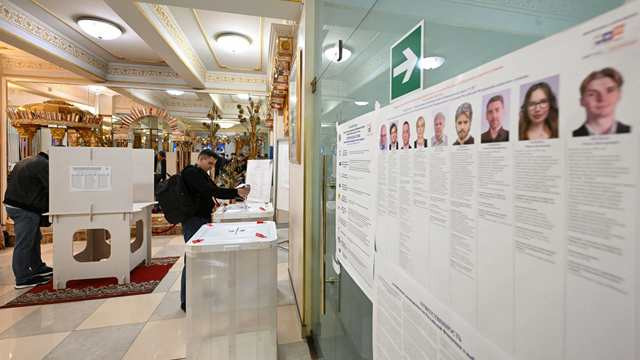
Russia is holding a three-day parliamentary election from Friday through Sunday, the country's first State Duma election since Moscow launched its full-scale invasion of Ukraine in 2022.
The vote comes as Russia faces a slowing economy, persistent inflation and Ukrainian drone attacks beyond the battlefield. President Vladimir Putin's ruling United Russia party is expected to retain its dominance in parliament, while critics argue that the outcome is largely predetermined because many genuine opposition candidates have been prevented from competing.
Voters are choosing all 450 members of the State Duma, Russia's lower house of parliament. Regional elections are also taking place, with governors being elected in 11 regions and members of regional legislatures in 39 regions.
Around 111 million people are eligible to vote, with electronic voting available in addition to traditional ballots. The election is being held over three days in an effort to increase voter participation.
Half of the State Duma's seats—225—are allocated through party lists, while the remaining 225 are contested in single-member constituencies.
United Russia was formed in 2001 through the merger of several pro-Kremlin parties. Since then, it has remained closely aligned with Putin and has dominated Russia's parliament.
In the 2021 parliamentary election, United Russia won more than two-thirds of the seats in the State Duma. The party is again expected to maintain its parliamentary dominance.
Foreign Minister Sergey Lavrov and Moscow Mayor Sergey Sobyanin are leading the party's candidate lists.
Among the prominent new faces is war correspondent Yevgeny Poddubny, who was seriously injured in a Ukrainian drone attack. His inclusion is part of the party's effort to bring new figures into its ranks.
United Russia members have backed the continuation of Russia's war in Ukraine and Putin's stated objectives. The Kremlin continues to describe the conflict as a “special military operation.”
Alongside United Russia, several so-called systemic opposition parties are taking part in the election. These parties frequently vote with the government on major issues.
The liberal Yabloko party had been the only registered party openly opposing the war in Ukraine. Although it initially appeared on the election ballot, Russia's Supreme Court removed its party list in August.
The court cited several reasons, including accusations that the party's anti-war position amounted to calls for actions against Russia's territorial integrity. Yabloko is now fielding candidates only in single-member constituencies.
The Communist Party of the Russian Federation remains another major political force. Its 82-year-old leader, Gennady Zyuganov, has headed the party for more than three decades and is a former Soviet official.
Although the Communist Party has criticised some government policies during Putin's more than 25 years in power, it has generally avoided directly attacking the president and strongly supports Russia's war in Ukraine.
Political analyst and independent journalist Alexander Bratersky told Al Jazeera that the race for second place will also be worth watching.
He said a strong performance by the Communist Party could indicate voter dissatisfaction linked to economic difficulties and declining living standards.
The Liberal Democratic Party of Russia (LDPR) is also expected to retain some influence in parliament. The party is known for its nationalist positions and has maintained a significant presence in Russian politics since the early 1990s. Like the Communists, it strongly supports the war in Ukraine and includes several former soldiers among its members.
Other parties competing include A Just Russia — Patriots — For Truth and New People.
A Just Russia has been active in Russian politics for around two decades and competes with the Communist Party for support among older and middle-aged voters who are nostalgic for the Soviet era. It also supports the war in Ukraine.
New People was founded shortly before the 2021 election and has sought to position itself as a more liberal party representing younger voters and members of the technology sector. It won slightly more than 5% of the vote in 2021 and formed a small parliamentary faction.
According to Bratersky, New People is relatively liberal and has attracted support from some technocratic and comparatively moderate figures within the Kremlin establishment. Some observers have viewed the party as a possible alternative to Yabloko after the latter faced restrictions.
Smaller parties, including Communists of Russia, the Party of Pensioners, the Green Party, the Party of Direct Democracy and Rodina, are also competing for seats.
Bratersky said the election carries particular political significance because it is the first parliamentary vote since Russia launched its full-scale war against Ukraine.
At United Russia's party congress in August, Putin urged the party to “do everything for victory” in the war, linking the election campaign to support for Russia's military objectives.
Bratersky said the election could nevertheless present a challenge for the Kremlin because voting remains one of the few legal avenues through which citizens can express dissatisfaction with the authorities.
United Russia has won every State Duma election since Putin came to power in 2000, often by wide margins. However, the results of several elections have been disputed.
The 2011 election triggered some of the largest street protests of Putin's rule following allegations of widespread electoral fraud.
After the 2021 election, independent observers and statisticians also argued that United Russia's actual level of public support was significantly lower than the official results indicated.
Russian authorities have rejected allegations of widespread electoral fraud. At the same time, opposition groups and critics of the war in Ukraine have faced increasingly limited opportunities to participate in elections.
Advertisement