৭ কার্তিক ১৪৩৩



Conflicting Signals from Trump Administration Raise Questions Over Iran War Strategy
11 March 2026 07:03 AM
NEWS DESK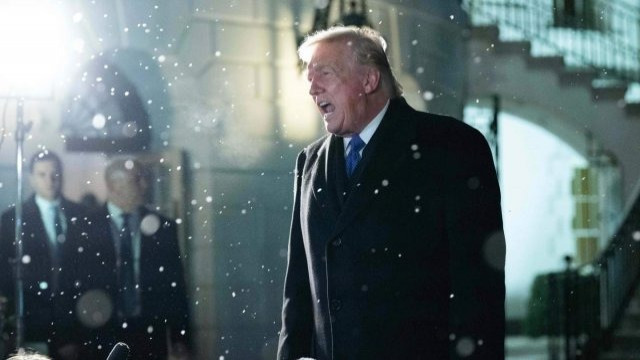
Conflicting statements from U.S. President Donald Trump and his administration have created uncertainty about the future and objectives of the joint U.S.–Israeli military campaign against Iran. Now in its tenth day, the operation has raised more questions than answers regarding its timeline and strategic goals.
On Monday morning U.S. time, after a sharp fall in the American stock market and a sudden spike in oil prices, Trump personally called several journalists in an attempt to calm the situation. However, his remarks appeared to create further confusion rather than providing clear direction.
Responding to a question from a New York Post reporter about rising oil prices, Trump said, “I have a plan for everything. You will be very happy.”
In an interview with CBS News, he claimed the war was “effectively nearing its end.”
“The war is almost finished. We are far ahead of schedule,” Trump said.
When asked whether the conflict could end quickly, he replied, “I don’t know. Ending it is in my head, not anyone else’s.”
His remarks had an immediate economic impact. U.S. stock markets partially recovered, while oil prices—which had surged to about $120 per barrel earlier in the day—fell back to below $90.
However, just days earlier Trump had said the war would not end until Iran agreed to an “unconditional surrender.” His comments had suggested the campaign—which has destabilized the Middle East and nearly halted shipping through the Strait of Hormuz—might be nearing its conclusion. Later in the evening, though, Trump appeared to shift his position again.
“At this moment we can call it a tremendous success,” he said. “But we can also go further. And we will go further.”
Trump also claimed the United States is “very close to finishing” the military campaign. At the same time, he warned that if Iran continues threatening oil tankers leaving the Persian Gulf, the U.S. would intensify its attacks.
“We will strike in such a way that they or their partners will not be able to recover in that region,” he said.
Trump also described the mission’s objective in broader terms, stating that the operation aims to prevent Iran from developing weapons that could be used against the United States, Israel, or their allies for a long time.
His remarks also hinted that regime change in Iran could ultimately be necessary to achieve that goal.
The repeated shifts in Trump’s messaging within just a few hours have deepened uncertainty about the real objectives and timeline of the war.
Earlier on Sunday, U.S. Defense Secretary Pete Hegseth suggested that more powerful weapons could soon be used in the campaign. He said the United States and Israel have the capability to conduct large-scale strikes using conventional bombs weighing 500, 1,000, and 2,000 pounds.
“In fact, we have not yet fully begun that effort,” Hegseth said.
When Trump was asked Monday whether his comments contradicted those of Hegseth, he replied, “Both can be true.” He later added, “This is the beginning of building a new country.”
However, Trump and his allies have previously stated they do not want to become involved in a nation-building process similar to the U.S. effort in Iraq after the 2003 invasion.
Meanwhile, the economic impact of the conflict is also creating political pressure within the United States. Investors are expected to evaluate Trump’s latest remarks on Tuesday, although analysts believe it may take more time for energy prices to stabilize.
The average price of gasoline in the United States has now reached $3.48 per gallon, about 48 cents higher than a week ago.
Signs of economic weakness are also emerging. According to data released Friday by the U.S. Bureau of Labor Statistics, the country lost 92,000 jobs in February. The unemployment rate has risen to 4.4 percent, while the labor force participation rate has fallen to 62 percent—the lowest level since December 2021.