[email protected]
শুক্রবার, ৬ নভেম্বর ২০২৬
২২ কার্তিক ১৪৩৩
২২ কার্তিক ১৪৩৩

Friday, 6th November 2026


Muslim Women Make US Electoral History as Hijab-Wearing Candidates Score Landmark Victories
05 November 2026 22:11 PM
NEWS DESK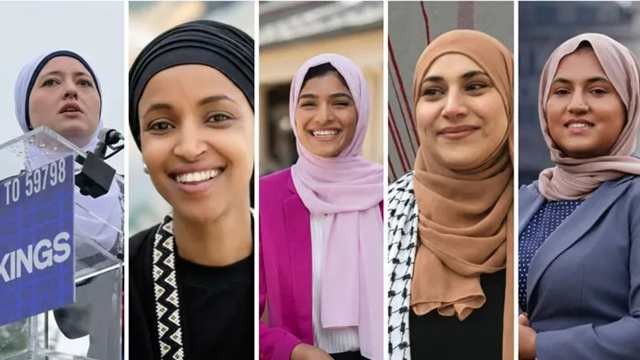
Tuesday’s US midterm elections witnessed several historic breakthroughs, including the election of four hijab-wearing women to state senates and the re-election of a Muslim congresswoman, marking a record moment for Muslim representation in American politics.
The victories came amid heightened anti-Muslim rhetoric and threats since President Donald Trump’s administration took office in January 2025, making the electoral results particularly significant.
These women have faced ridicule, caricatures and personal attacks from sections of corporate media, Republicans and online trolls, with some of the hostility reportedly putting their safety at risk.
Last week, the Muslim Public Affairs Council (MPAC) expressed concern over the growing activities of far-right and anti-Muslim provocateurs in the United States. The organisation warned that such rhetoric could encourage tougher law enforcement measures and potentially discourage American Muslims from exercising their right to vote.
Although voter turnout figures are still being assessed, several young Muslim women who visibly identify with their faith have now secured elected positions and are preparing to take office.
All of them are progressive Democrats.
In Georgia, a relatively conservative southern state that has recently witnessed significant political milestones, State Representative Ruwa Romman won her race for the state Senate.
Romman had already made history as the first Muslim woman to serve in the Georgia legislature while wearing a hijab.
She gained national attention during the 2024 presidential election when pro-Palestinian Democrats urged the Democratic National Committee and then-presidential candidate Kamala Harris to allow a Palestinian speaker to address the party's national convention. The request was ultimately rejected.
Romman, whose grandfather was born in Jerusalem, had been expected to deliver that speech. At the time, she had already served as an elected official for two years.
The Biden administration's strong support for Israel's military campaign in Gaza, which UN officials and Holocaust scholars have described as genocide, contributed to declining Democratic support among younger voters and helped pave the way for the party's electoral setbacks.
Palestinian-American candidates break barriers in New York
In New York, Abir Kawas is set to join the state Senate in January.
Like Romman, Kawas is a Palestinian immigrant to the United States. Earlier this year, she told Middle East Eye that she viewed collective action and civic participation as essential ways of building unity in her adopted city.
Her political journey is deeply connected to her family's experience of discrimination following the September 11, 2001 attacks.
In the years after the attacks, her undocumented father was arrested by agents of US Immigration and Customs Enforcement (ICE), amid a broader crackdown on Muslim communities across New York City and the country. The campaign included FBI raids, detentions and extensive surveillance of mosques and other Muslim institutions.
Kawas's father was held for nearly three years before being deported to Jordan.
Some of her most painful childhood memories involve watching her distressed mother speak to her father through a glass partition at a detention facility. She described the facility as a mixed-use detention centre housing not only civil immigration detainees but also people accused of criminal offences.
The increasingly visible and aggressive ICE enforcement operations in public spaces have sparked widespread concern and political backlash, contributing to what Democrats have described as a sweeping electoral victory.
In Illinois, 27-year-old State Representative Nabeela Syed comfortably defeated her Republican opponent, securing victory by a five-percentage-point margin despite facing a competitive challenge.
The Indian-American politician first entered the state legislature in 2022 after winning a special election to fill a vacant seat.
Her political agenda has focused on reducing the cost of living and promoting greater equity in healthcare.
The Daily Herald, a 150-year-old newspaper covering the greater Chicago area, and the influential Chicago Tribune recently endorsed her candidacy.
Like Romman and Kawas, Syed has been critical of Israel's actions.
On October 8, 2023, a day after the Hamas-led attack on southern Israel, she joined several other Illinois lawmakers in signing a joint letter urging Washington to push for a ceasefire.
Critics accused the lawmakers of effectively defending Hamas.
The letter stated: “We will never achieve peace by denying millions of Palestinians their basic human rights.” It also called on the United States and the international community to pursue a long-term solution addressing the inequalities underlying the conflict.
In Connecticut, State Representative Mariam Khan is set to join the state Senate in January after defeating her Republican opponent by a landslide.
Khan, who has served in the state House since 2022, defeated a Democratic incumbent who had held office for nearly a decade in the August primary.
Born in Pakistan, Khan has held several influential positions in the state legislature, including chair of the House Judiciary and Education Committees, as well as serving on the Select Committee on Special Education.
Connecticut Senate Democratic Majority Leader Bob Duff welcomed her to the chamber in a post on X, describing her as a former special education teacher and a passionate advocate for children's rights.
Earlier this year, Khan faced criticism from Republicans for displaying a Pakistani flag on her desk after Pakistan helped facilitate post-war ceasefire negotiations between the United States and Iran.
Speaking to The Connecticut Mirror, Khan defended the gesture, saying the flag reflected her heritage and personal pride.
She said any suggestion that displaying the Pakistani flag was inappropriate or disloyal was entirely false.
“Pakistan is a longstanding diplomatic partner of the United States, and recognising my roots does not diminish my commitment to this country or to serving the people of Connecticut,” she said.
Perhaps no one understands the weight of Republican opposition better than Minnesota Congresswoman Ilhan Omar, who secured re-election to the US House of Representatives for a fifth term on Tuesday.
In 2018, Omar became one of only four Muslims serving in the US House of Representatives and the only one wearing a hijab.
Since then, she has remained a frequent target of attacks by Trump.
Just two weeks before the election, federal agents from Homeland Security Investigations reportedly raided Omar's home before dawn, seizing her cellphone, laptop and other electronic devices.
Born in Somalia, Omar arrived in the United States in 1995 as a child refugee. She became a US citizen at the age of 17 after her late father had obtained citizenship.
The Justice Department is reportedly examining whether Omar was actually 18 at the time, which could have affected the citizenship application process she was required to follow.
Trump has repeatedly called for an investigation into her citizenship and has accused her of marrying her own brother to exploit the immigration system. Omar has denied the allegations.
Over the past year, Trump and Vice President JD Vance have repeatedly argued that she should be investigated. At campaign rallies, Trump supporters have also chanted “Send her back”.
The Wall Street Journal, citing unnamed US officials, reported that the administration was preparing a case aimed at stripping Omar of her citizenship and deporting her.
According to The Washington Post, nearly 100 Republican members of Congress have posted about Islam or Muslims on social media since early 2025. Almost all the posts were negative, with some lawmakers calling for Muslims to be expelled from the country.
A separate report by the Center for the Study of Organized Hate found that between February 2025 and March 2026, Republicans engaged in what it described as a coordinated anti-Muslim campaign involving 1,111 social media posts, eight legislative bills and a congressional caucus comprising 62 members.
The report said many of the posts met five criteria associated with language that could incite violence.
Haris Tarin, vice president of policy and programming at the Muslim Public Affairs Council, told Middle East Eye on Wednesday that the growing climate of Islamophobia had ultimately backfired against those promoting it.
He pointed out that Omar had won by a wider margin than in her previous elections, while several other visibly Muslim women had also secured victories.
According to Tarin, the results demonstrate that anti-Muslim rhetoric failed to deliver the political outcome its proponents had hoped for.
“Islamophobia was not a winning strategy in this election cycle,” he said.
The victories represent a significant milestone for Muslim political representation in the United States, highlighting the growing role of young, progressive Muslim women in American public life despite persistent discrimination and political hostility.
Advertisement