২২ কার্তিক ১৪৩৩



Trump’s 250-Foot Mega Arch Project Faces Legal Setback as Federal Judge Halts Construction
06 November 2026 18:11 PM
NEWS DESK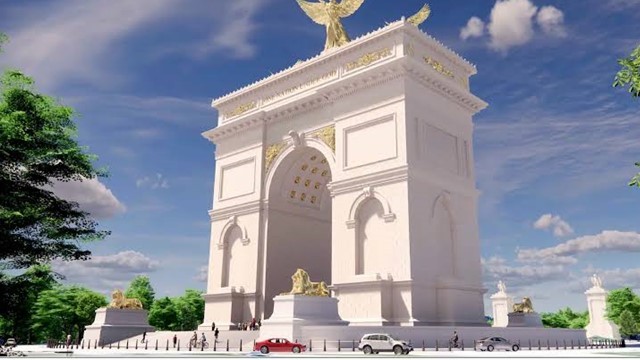
US President Donald Trump’s ambitious plan to build a massive 250-foot-tall triumphal arch in Washington, D.C., has suffered a major legal setback after a federal judge temporarily halted all construction-related activities for 15 days, just an hour after the controversial project received final approval.
US District Judge Tanya Chutkan issued the temporary restraining order late Thursday, following more than eight hours of public hearings and strong opposition from citizens, veterans and historic preservation advocates.
The judge, who was appointed during the Obama administration, directed the Trump administration and other defendants not to begin or carry out any construction-related activities at or around the proposed site. In a subsequent memorandum, Chutkan cited serious concerns about the project's potential economic impact and the risk of severe traffic congestion.
Earlier on Thursday night, the National Capital Planning Commission (NCPC), one of two major federal agencies overseeing architectural and planning changes in Washington, approved the controversial project by an 8-4 vote during a virtual meeting.
Before the vote, more than 120 members of the public, many of them military veterans, urged the commission to reject or postpone the proposal.
The commission, whose members include Trump loyalists and presidential appointees, moved ahead with final approval despite mounting opposition. The administration has been eager to advance construction before a Democratic-controlled Congress takes office in January.
Trump hopes to complete the structure within the next two years, before the end of his current presidential term. The proposed monument is being promoted as what would become the world's largest triumphal arch.
However, the ambitious timeline has faced significant legal challenges and public controversy from the outset.
A high-profile lawsuit has been filed by wounded military veterans and historic preservation groups challenging the approval process. They argue that the arch's enormous size and proposed location would damage the historic landscape of the US capital.
In particular, opponents say the structure would disrupt important sightlines connecting the Lincoln Memorial, Arlington House and the Robert E. Lee Memorial. They also warn that it would undermine the solemn atmosphere surrounding Arlington National Cemetery.
The central legal argument against the project is that it is unlawful because Congress has not authorised its construction. Under the Commemorative Works Act, congressional approval is required for the establishment of new commemorative monuments in Washington.
Protests and demonstrations took place throughout Thursday near the proposed construction site. Democratic Representative Don Beyer, whose district includes the area surrounding Arlington National Cemetery, joined the demonstrations and described the proposed structure as a grotesque monument to one man's ego and an insult to every fallen American service member buried there.
However, even before the commission meeting, its chairman had publicly described the project as a historic undertaking by Trump and indicated his support for it.
The arch is part of a broader series of ambitious projects being pursued during Trump's second term, including renovations to the Lincoln Memorial Reflecting Pool and the Kennedy Center. Critics have characterised several of these initiatives as attempts by the president to leave a personal architectural legacy.
Last October, Trump displayed scale models of the proposed arch in the Oval Office. When a journalist asked whom the monument would honour, Trump reportedly pointed to himself and replied, "Me."
He later argued that the structure would commemorate the 250th anniversary of American independence and symbolise the nation's spirit, military strength and capabilities.
More recently, Trump offered another justification, claiming that the arch, planned near a busy traffic circle close to the Potomac River, could serve not only as a tourist attraction but also as a military complex for storing drones and ammunition.
However, the final documents submitted to the NCPC on Thursday made no reference to any military component. Administration officials nevertheless maintained that such facilities could potentially be incorporated later without fundamental changes to the project.
In an effort to accelerate construction, the administration had reportedly planned round-the-clock operations using two 10-hour shifts each day.
During Thursday's court proceedings, however, the National Park Service (NPS) acknowledged that a contractor hired by the agency had already marked out areas around the proposed site without obtaining the necessary authorisation. The agency assured the court that such activities would not continue.
Michael Lemon, the lead plaintiff in the lawsuit, argued during the hearing that the entire review process had been rushed towards a predetermined outcome. He alleged that Congress had deliberately been excluded and that professional assessments of the project's potential adverse effects on Arlington had been disregarded.
Democratic Representative Jared Huffman, who is expected to become chairman of the House Natural Resources Committee, which oversees the National Park Service, also criticised the initiative.
He described it as an affront to American values and the rule of law, arguing that the president should not be allowed to satisfy personal ambitions at the expense of public interest, particularly as the country approaches its 250th anniversary.
An assessment published by the National Park Service last August acknowledged that the proposed arch could negatively affect approximately 42 historic sites. Six of those locations, including Arlington National Cemetery and the Lincoln Memorial, were identified as facing particularly serious impacts.
According to the assessment, the structure would also be visible from Capitol Hill, the Georgetown waterfront and the Pentagon, potentially disrupting the historic visual character of Washington.
Although the National Park Service examined alternative locations, it ultimately identified the Potomac River waterfront as the only suitable site for the proposed monument.
Under Section 106 of the National Historic Preservation Act, projects of this nature require consultation with relevant independent historic preservation organisations and other stakeholders.
However, last month, the Trump administration formally concluded the consultation process under Section 106 without reaching an agreement, opting instead to move directly towards implementation.
Within just 30 minutes of the NCPC's final approval on Thursday, the Interior Department announced that the administration would proceed with the project.
The federal judge's immediate intervention has now brought Trump's fast-tracked construction plans to a temporary halt.
The legal setback comes amid broader political challenges for the president following recent midterm election losses, in which Democrats secured control of both chambers of Congress. With the judiciary now also standing in the way of one of his signature architectural ambitions, Trump faces another significant obstacle to his plans for reshaping the nation's capital.