৪ কার্তিক ১৪৩৩



Turkey Seeks Deeper Strategic Partnership with Bangladesh, Focuses on Defense Cooperation
06 June 2026 05:06 AM
NEWS DESK
Turkey is keen to deepen and expand its long-standing partnership with Bangladesh, with particular emphasis on strengthening cooperation in the defense industry. Turkish Foreign Minister Hakan Fidan outlined Ankara’s vision for future Bangladesh–Turkey relations during his three-day visit to Dhaka.
Speaking after bilateral talks with Bangladesh’s Foreign Minister Khalilur Rahman at the InterContinental Dhaka on Friday, Fidan emphasized Turkey’s commitment to elevating ties built on a strong foundation to a more comprehensive and forward-looking level.
A joint press conference was held following the meeting, though no questions were taken from journalists. Both ministers delivered prepared statements before departing the venue.
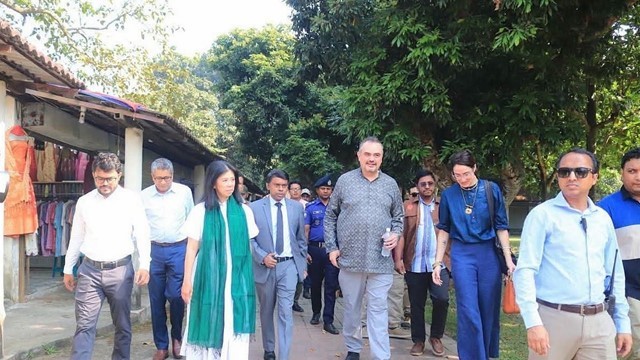
Fidan arrived in Dhaka from Seoul on Thursday night for a three-day official visit. After the bilateral meeting and a luncheon hosted in his honor, he traveled to Cox's Bazar to observe the situation of the Rohingya refugees. He is scheduled to return to Dhaka later in the evening and meet Prime Minister Tarique Rahman on Saturday before concluding his visit.
Cultural Heritage Cooperation Agreement Signed
Following the talks, Bangladesh and Turkey signed a Memorandum of Understanding (MoU) on cooperation in the preservation of cultural heritage.
The agreement opens the door for long-term collaboration in areas including cultural heritage conservation, protection of archaeological assets, museum management, preservation of archival records and library materials, digitization, and restoration activities.
Under the MoU, both countries will work together to prevent the illicit import, export, and transfer of ownership of cultural property in line with the 1970 UNESCO Convention. The agreement also promotes cooperation in archaeological research, the use of modern technologies, disaster risk reduction, and documentation of cultural assets.
Officials described the agreement as a significant milestone in bilateral cultural relations.
Broad Agenda Covers Trade, Investment, and Regional Issues
The Dhaka meeting took place just three months after the two foreign ministers met in Ankara. The discussions included a delegation-level session followed by a private one-on-one meeting lasting approximately 30 minutes.
Although no formal agenda was announced, the talks covered bilateral relations, regional developments, and international issues.
Addressing the press, Rahman said Bangladesh’s foreign policy under Prime Minister Tarique Rahman is guided by the principle of “Bangladesh First,” emphasizing national interests and sovereignty while fostering relationships based on equality and mutual respect.
“Bangladesh seeks friends and partners, not masters,” he stated.
The ministers also held positive discussions regarding the possibility of signing a Free Trade Agreement (FTA) and a Preferential Trade Agreement (PTA).
One of Bangladesh’s key proposals was the establishment of a dedicated Special Economic Zone for Turkish investors. Officials believe such an initiative could attract substantial Turkish investment in sectors including ready-made garments, textiles, shipbuilding, pharmaceuticals, information technology, renewable energy, and infrastructure.
Defense Cooperation a Key Priority
Highlighting future cooperation, Fidan said Turkey is exploring ways to increase bilateral trade from the current $1.3 billion to $2 billion.
“We can take steps to enhance our cooperation in various fields, particularly in the defense industry,” he said.
The Turkish foreign minister also noted that both countries agreed to strengthen coordination and cooperation on regional and international issues where their interests align.
Health, Education, and People-to-People Ties
Beyond economic and defense cooperation, Bangladesh expressed interest in leveraging Turkey’s expertise in healthcare. Rahman said Dhaka has proposed Turkish involvement in establishing or upgrading an international-standard hospital and nursing institute in Bangladesh.
The Bangladeshi side also requested an increase in scholarships for Bangladeshi students pursuing higher education in Turkey. Approximately 3,000 Bangladeshis currently reside in Turkey, most of them students.
The government hopes that expanded educational and cultural exchanges will further strengthen people-to-people ties between the two nations.
Continued Support for Rohingya Refugees
On the Rohingya crisis, Fidan reaffirmed Turkey’s commitment to supporting efforts aimed at achieving a lasting and just solution.
“We continue to work in solidarity and coordination with neighboring countries and relevant organizations to keep this issue on the international agenda,” he said.
He pledged that Turkey would maintain humanitarian assistance for the Rohingya community while supporting their safe, dignified, and voluntary repatriation to their homeland.
Emphasis on Regional Stability and Global Peace
Addressing broader geopolitical developments, Fidan warned that regional conflicts are increasingly affecting global stability.
He noted that ongoing tensions involving Iran have implications far beyond the region and welcomed progress in discussions between Iran and the United States.
“We hope these talks will produce tangible results and lay the foundation for lasting peace and stability,” he said.
Fidan stressed the importance of ensuring freedom of navigation through the Strait of Hormuz and restoring pre-conflict conditions, describing these objectives as essential for global economic stability, energy security, and food security.
He reiterated Turkey’s belief that disputes can only be resolved through dialogue and diplomacy and noted that Ankara continues consultations with the United States, Iran, and regional countries.
The Turkish foreign minister also praised Pakistan’s efforts to promote and sustain ceasefires, calling for stronger international commitment to ending conflicts and fostering peace.