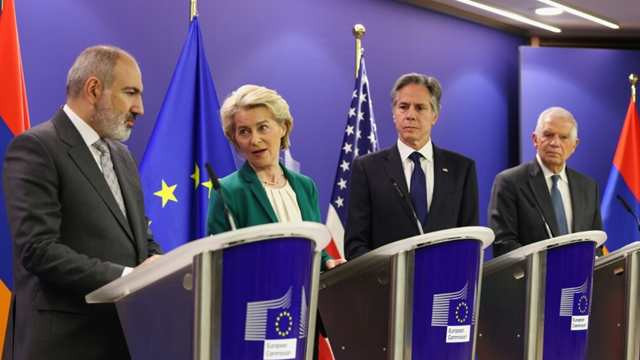
Leaders from more than 30 European countries, along with the Prime Minister of Canada, are gathering in Yerevan to attend two major summits, marking a potentially historic moment for the country.
On Monday, the summit of the European Political Community is taking place. The following day will see the first-ever bilateral summit between the European Union and Armenia. Key attendees include European Commission President Ursula von der Leyen and European Council President António Costa.
Despite these developments, Armenia remains a member of the Eurasian Economic Union, led by Russian President Vladimir Putin. Russia maintains a military base in Armenia, and the country is heavily dependent on Moscow for energy. Armenia receives natural gas from Russia at a significantly lower price—about $177.50 per thousand cubic meters—compared to nearly $600 in Europe.
Turning Point: The 2023 Conflict
A major factor behind Armenia’s shift is the 2023 conflict with Azerbaijan. During that time, Azerbaijan launched a rapid military operation in the disputed region of Nagorno-Karabakh, gaining full control and displacing over 100,000 ethnic Armenians.
Armenia accused Russia of inaction despite the presence of Russian peacekeepers. The Russia-led security alliance also failed to provide effective support, prompting concerns in Yerevan about the reliability of its existing security framework.
Growing Ties with Europe
In response, Armenia has been strengthening ties with Europe. The European Union has mediated border talks between Armenia and Azerbaijan and deployed a civilian monitoring mission, boosting trust among the Armenian public.
In March 2025, Armenia’s parliament passed legislation to begin the process of joining the European Union—an indication of a significant strategic shift.
A U.S.-mediated agreement signed in August between Armenia and Azerbaijan aims to end their long-standing conflict. It also includes plans for a regional corridor named the “Trump Route for International Peace and Prosperity,” designed to enhance connectivity with Europe.
However, peace remains fragile. Azerbaijan has recently suspended relations with the European Parliament, adding to diplomatic tensions.
Moscow’s Discontent
Moscow has made clear its dissatisfaction with Armenia’s pro-European tilt. During a meeting at the Kremlin, Vladimir Putin warned Armenian Prime Minister Nikol Pashinyan that it is not feasible to be a member of both the European Union and the Eurasian Economic Union simultaneously.
Russia has already imposed a ban on Armenian mineral water imports, a move widely seen as political pressure. Analysts suggest that Moscow may also be using hybrid tactics, including cyberattacks and disinformation campaigns, to influence Armenia.
Elections Ahead, Risks Rising
Armenia is set to hold national elections in June, raising concerns about stability. Ahead of the vote, the European Union has approved a new civilian mission aimed at countering disinformation, cyber threats, and foreign interference.
Alain Berset has warned that while Armenia’s democratic progress is visible, it remains under pressure.
An Uncertain Future
Although Europe has offered visa facilitation and cooperation, there is still no clear timeline for Armenia’s EU membership, nor any security guarantees or alternatives to Russian gas supplies.
As a result, analysts believe Armenia will need to continue a delicate balancing act—maintaining ties with Russia while deepening relations with Europe.
Overall, the summits in Yerevan are more than just diplomatic events; they represent a critical test of Armenia’s future direction on the global stage.